Sword
Mandau
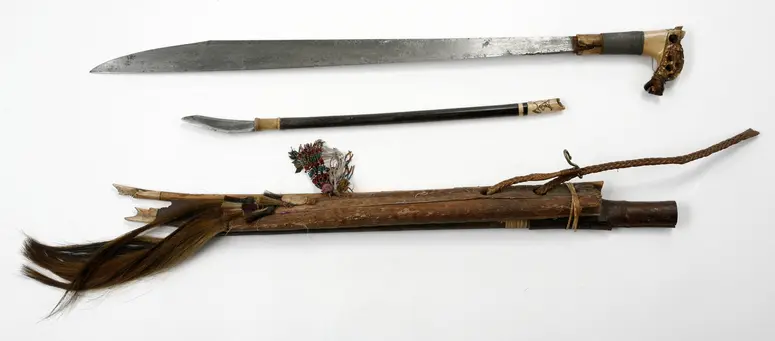
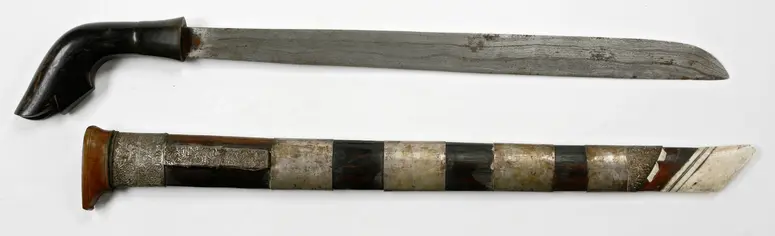
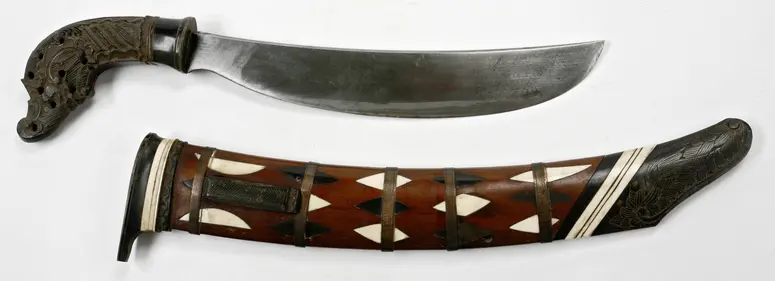
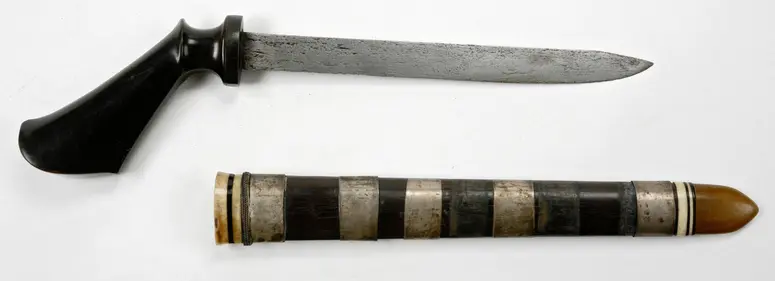
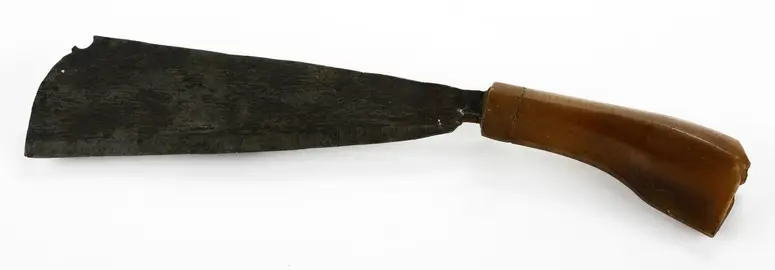
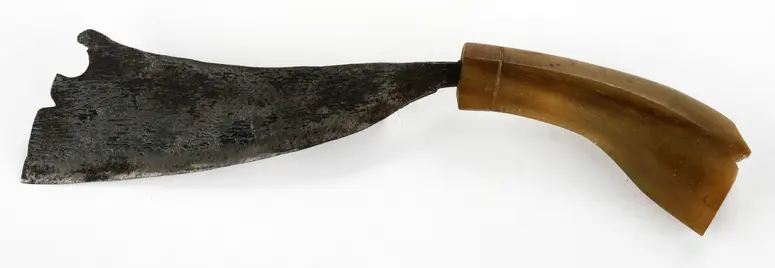
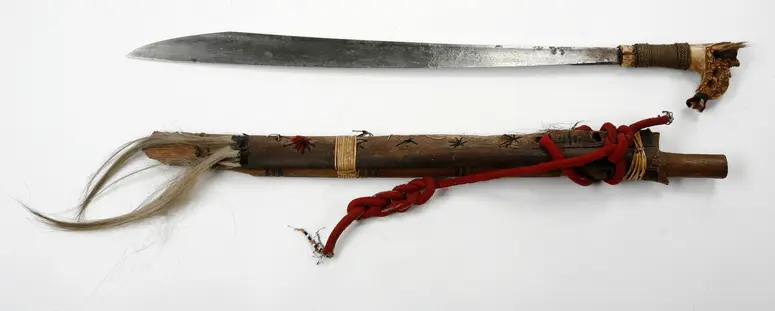
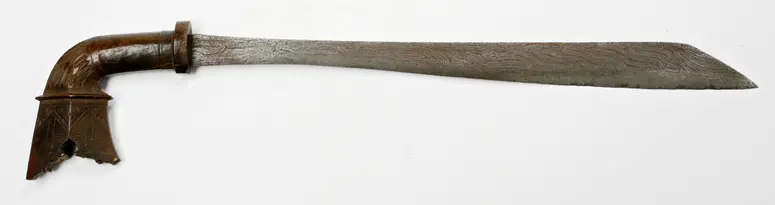
Note: The following text is taken from a 19th-century collection catalog and, in its language and perspective, partially reflects colonial thought patterns. We present the text in its original version to make the collection's history transparent and promote a critical examination of the colonial legacy. Certain terms and formulations may be perceived as problematic today. A 2009 research project concluded that most descriptions are factually correct and still usable; only a few details were found to be inaccurate or incorrect. The results of this project were published in the following collection catalog: khm-wmw-tm-library.on.worldcat.org/oclc/1457155265"35-36. Sword "Mando".The blade of this cutting weapon is similar to a kalewang but made of a very fine steel. The hilt is of bone and cut in the most beautiful manner and wound around by brass wire; the wooden sheath is decorated in a fantastic way with glass beads, "bock hair" and many-colored pieces of cloth. On the side of this sheath there is a second one which is narrow, long and made of bark. Both sheaths are bound together by rattan work. In this narrow, side sheath there is a small knife with a very long rod-shaped wooden hilt that is inlaid at the top and bottom with bone. This knife serves peaceful purposes, it is used for the various rattan work of the natives to split the rattan; since the native always has his sword at his side, he thus always has this knife available for work. The sword is carried on a finely braided band, usually of split rattan, around the body. The band itself is again decorated in various ways with copper rings, shells, glass beads, bits of cloth. This weapon can also be found on Borneo among the Dayaks the so-called head-hunters. With this weapon both peoples, both the Dayaks as well as the Alfuros and Buginese are able to cut off their enemies heads in battle with one blow. The severed heads are dried in the sun and then hung as trophies in the house of the winner. The reputation of the inhabitant of a house grows with the number of enemy heads which are hung up."Translation of: Czurda, F. A. J. (1883). Catalog mit Erklärungen der Etnografischen Privatsammlung des Dr. F. A. J. Czurda in Postelberg (Böhmen). (p. 6-7). Wien, Wilhelm Braumüller
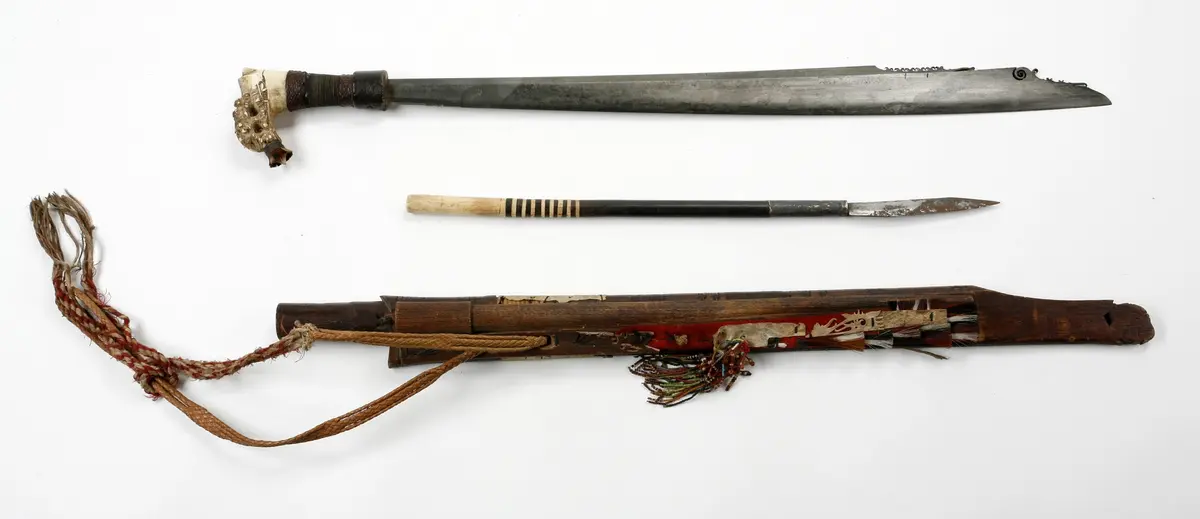
Note: The following text is taken from a 19th-century collection catalog and, in its language and perspective, partially reflects colonial thought patterns. We present the text in its original version to make the collection's history transparent and promote a critical examination of the colonial legacy. Certain terms and formulations may be perceived as problematic today. A 2009 research project concluded that most descriptions are factually correct and still usable; only a few details were found to be inaccurate or incorrect. The results of this project were published in the following collection catalog: khm-wmw-tm-library.on.worldcat.org/oclc/1457155265"35-36. Sword "Mando".The blade of this cutting weapon is similar to a kalewang but made of a very fine steel. The hilt is of bone and cut in the most beautiful manner and wound around by brass wire; the wooden sheath is decorated in a fantastic way with glass beads, "bock hair" and many-colored pieces of cloth. On the side of this sheath there is a second one which is narrow, long and made of bark. Both sheaths are bound together by rattan work. In this narrow, side sheath there is a small knife with a very long rod-shaped wooden hilt that is inlaid at the top and bottom with bone. This knife serves peaceful purposes, it is used for the various rattan work of the natives to split the rattan; since the native always has his sword at his side, he thus always has this knife available for work. The sword is carried on a finely braided band, usually of split rattan, around the body. The band itself is again decorated in various ways with copper rings, shells, glass beads, bits of cloth. This weapon can also be found on Borneo among the Dayaks the so-called head-hunters. With this weapon both peoples, both the Dayaks as well as the Alfuros and Buginese are able to cut off their enemies heads in battle with one blow. The severed heads are dried in the sun and then hung as trophies in the house of the winner. The reputation of the inhabitant of a house grows with the number of enemy heads which are hung up."Translation of: Czurda, F. A. J. (1883). Catalog mit Erklärungen der Etnografischen Privatsammlung des Dr. F. A. J. Czurda in Postelberg (Böhmen). (p. 6-7). Wien, Wilhelm Braumüller
Collector:
František A. J. Czurda (1844 Pisek - 1886 Cirebon) DNB
Entry Date:
1883
Object Name
Sword
Culture
Borneo
Material/technology:
Iron; forged, horn, wire, hair. Small knife: iron; forged, horn. Sheath: wood, bast, rattan, cloth, glass beads
Copyright
Weltmuseum Wien
Collection area
Insular Southeast Asia
Invs.
17352