Wick
Tali-api
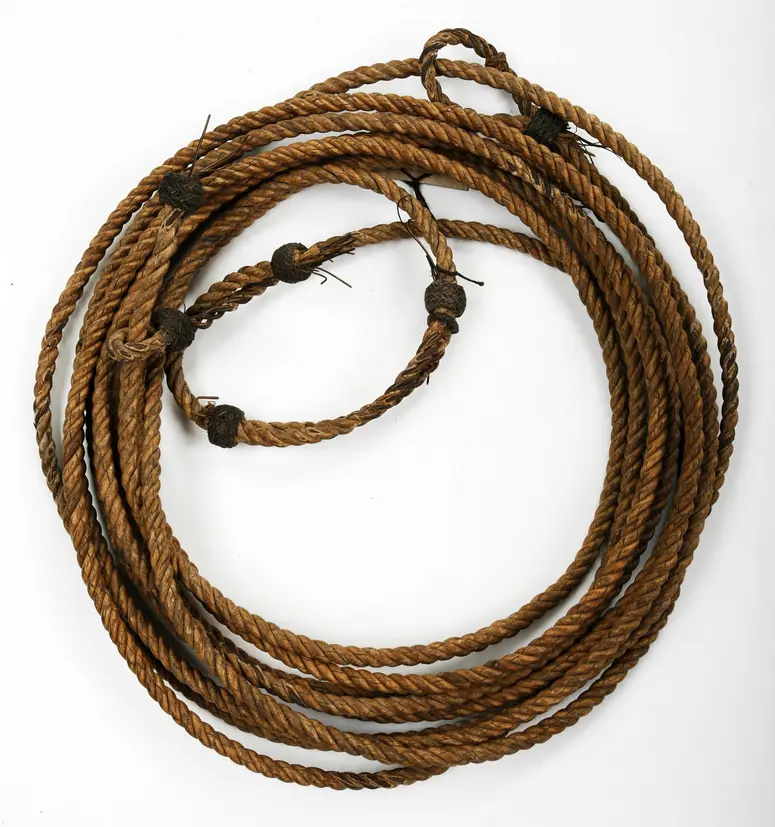
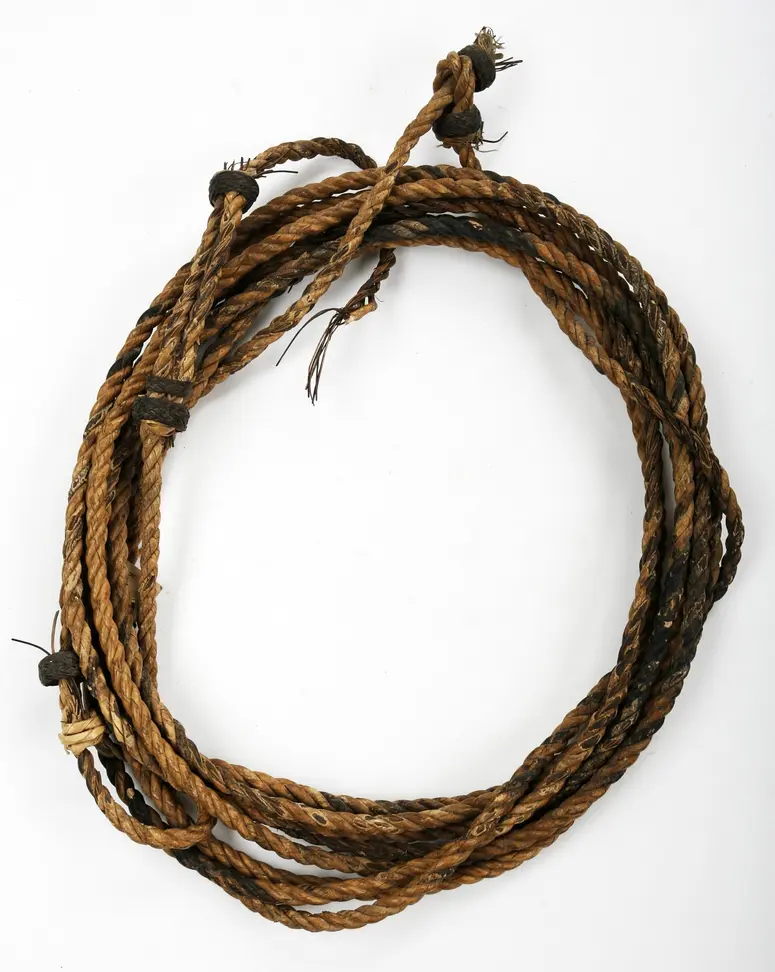
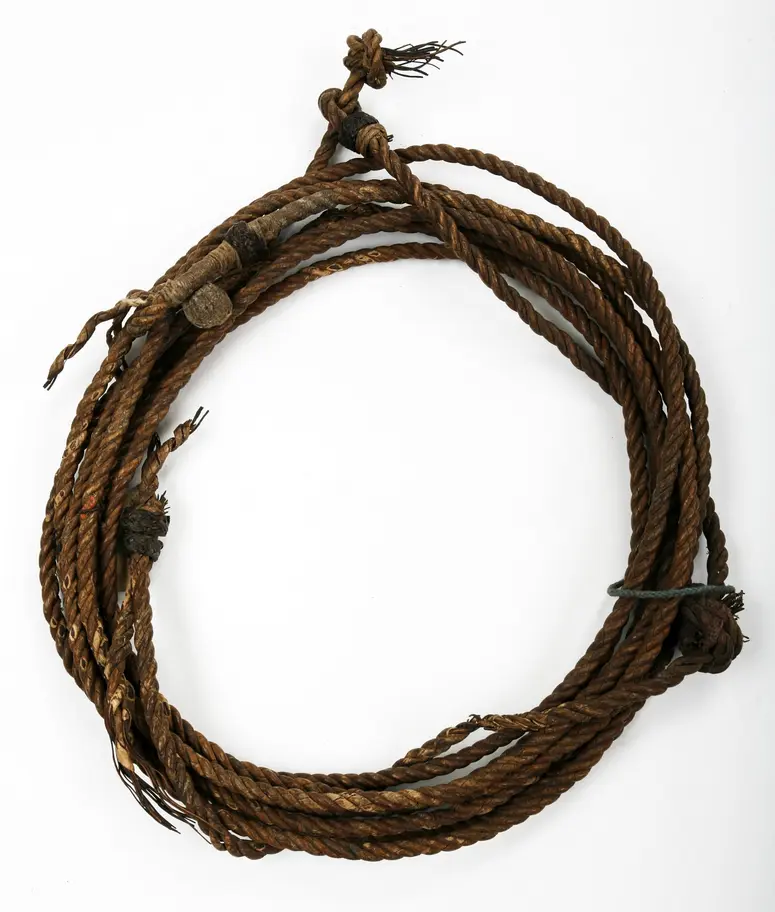
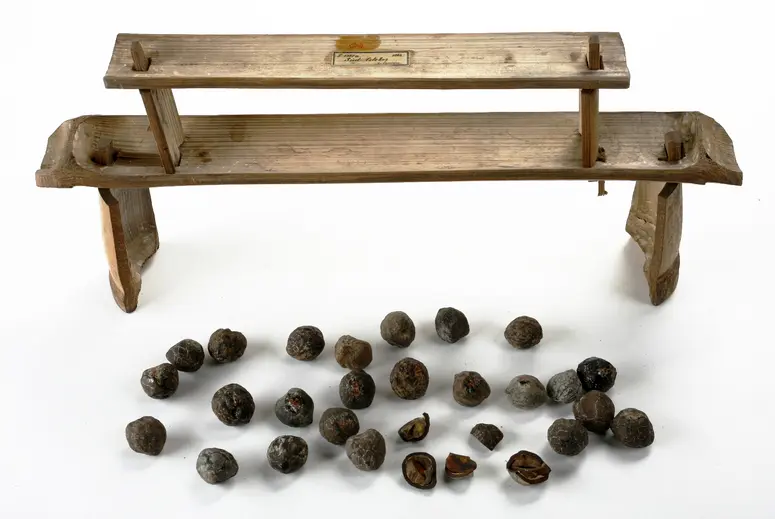
Note: The following text is taken from a 19th-century collection catalog and, in its language and perspective, partially reflects colonial thought patterns. We present the text in its original version to make the collection's history transparent and promote a critical examination of the colonial legacy. Certain terms and formulations may be perceived as problematic today. A 2009 research project concluded that most descriptions are factually correct and still usable; only a few details were found to be inaccurate or incorrect. The results of this project were published in the following collection catalog: khm-wmw-tm-library.on.worldcat.org/oclc/1457155265"287 - 288. WicksThe wicks, in Malayan called "tali-api", have the form of a little stick and are made by binding together coconut fibres with hemp string. They are found generally in the possession of Europeans; they glow all day and usually are under the care of a small native boy, the "tali-api" boy. He follows his master with the burning wick in his hand, crouches down close to his master, follows him on his walks, stands on the runner of the car and is to be found everywhere where his master is. At a social affair or at the casino there have to be several "tali-api" boys who are always ready when the call "api", "fire" comes to light the new or extinguished cigar. Matches are almost never used by the Europeans for lighting cigars. High officials have themselves followed by their uniformed, native servants on the promenade carrying such burning wick."Translation of: Czurda, F. A. J. (1883). Catalog mit Erklärungen der Etnografischen Privatsammlung des Dr. F. A. J. Czurda in Postelberg (Böhmen). (p. 60). Wien, Wilhelm Braumüller
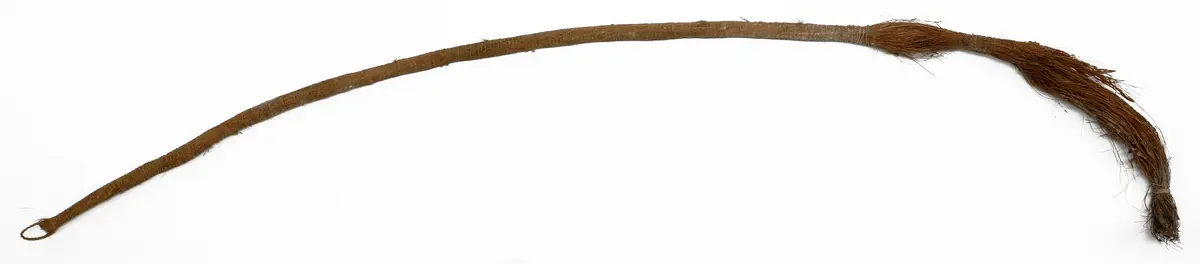
Note: The following text is taken from a 19th-century collection catalog and, in its language and perspective, partially reflects colonial thought patterns. We present the text in its original version to make the collection's history transparent and promote a critical examination of the colonial legacy. Certain terms and formulations may be perceived as problematic today. A 2009 research project concluded that most descriptions are factually correct and still usable; only a few details were found to be inaccurate or incorrect. The results of this project were published in the following collection catalog: khm-wmw-tm-library.on.worldcat.org/oclc/1457155265"287 - 288. WicksThe wicks, in Malayan called "tali-api", have the form of a little stick and are made by binding together coconut fibres with hemp string. They are found generally in the possession of Europeans; they glow all day and usually are under the care of a small native boy, the "tali-api" boy. He follows his master with the burning wick in his hand, crouches down close to his master, follows him on his walks, stands on the runner of the car and is to be found everywhere where his master is. At a social affair or at the casino there have to be several "tali-api" boys who are always ready when the call "api", "fire" comes to light the new or extinguished cigar. Matches are almost never used by the Europeans for lighting cigars. High officials have themselves followed by their uniformed, native servants on the promenade carrying such burning wick."Translation of: Czurda, F. A. J. (1883). Catalog mit Erklärungen der Etnografischen Privatsammlung des Dr. F. A. J. Czurda in Postelberg (Böhmen). (p. 60). Wien, Wilhelm Braumüller
Collector:
František A. J. Czurda (1844 Pisek - 1886 Cirebon) DNB
Entry Date:
1883
Object Name
Wick
Culture
Süd-Sulawesi
Material/technology:
Fibres of coconut; bound
Copyright
Weltmuseum Wien
Collection area
Insular Southeast Asia
Invs.
17540