Basket
Rantang
Note: The following text is taken from a 19th-century collection catalog and, in its language and perspective, partially reflects colonial thought patterns. We present the text in its original version to make the collection's history transparent and promote a critical examination of the colonial legacy. Certain terms and formulations may be perceived as problematic today. A 2009 research project concluded that most descriptions are factually correct and still usable; only a few details were found to be inaccurate or incorrect. The results of this project were published in the following collection catalog: khm-wmw-tm-library.on.worldcat.org/oclc/1457155265"200. Basket - "Rantang".A basket of a very peculiar shape and equipment, which is possibly only found here on South Celebes. It forms a kind of cut off cone which is comprised of several layers or levels, each of which is a round basket for itself; and each of which can be stacked on top of the next. The upper-most has a cover so that the whole thing has a form similar to a tower. The present basket is about one meter high and is comprised of five levels, that is, of five separate baskets and one lid. It is woven from finely split, variously colored lontar leaves whereby the bottoms of the individual baskets are stiffened by rings of rattan so that the whole has a great strength. The variously colored lontar leaves which have been used for the weaving have been arranged in delicate and regular figures next to each other and the whole illustrates the taste and sense of color of the natives. These types of basket are not only used to store fruit and different sweets, they are also well suited for sending gifts on festive occasions to acquaintances of higher standing, and rulers. For such an occasion each compartment is filled with a different cake or different fruit. Depending on the rank, position and wealth of the giver, there would be a larger of smaller number of such baskets filled with presents sent to the person concerned as a "cadeau" or gift."Translation of: Czurda, F. A. J. (1883). Catalog mit Erklärungen der Etnografischen Privatsammlung des Dr. F. A. J. Czurda in Postelberg (Böhmen). (p. 48). Wien, Wilhelm Braumüller
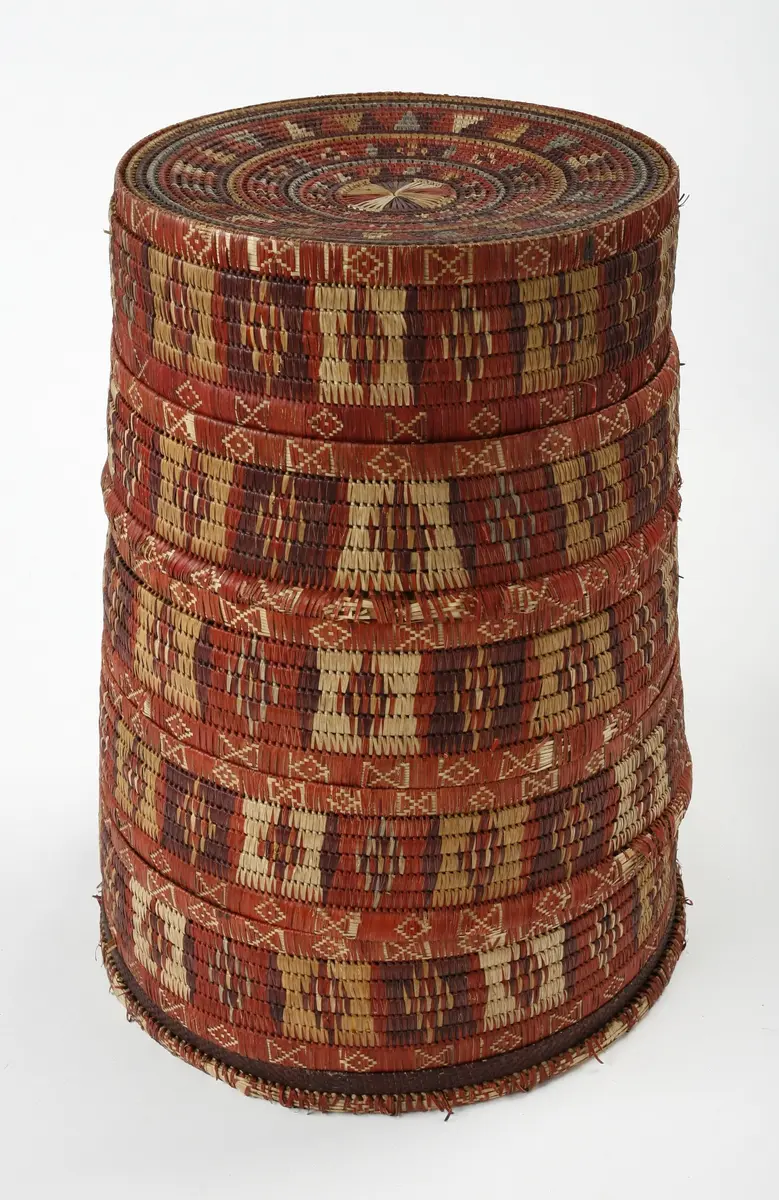
Note: The following text is taken from a 19th-century collection catalog and, in its language and perspective, partially reflects colonial thought patterns. We present the text in its original version to make the collection's history transparent and promote a critical examination of the colonial legacy. Certain terms and formulations may be perceived as problematic today. A 2009 research project concluded that most descriptions are factually correct and still usable; only a few details were found to be inaccurate or incorrect. The results of this project were published in the following collection catalog: khm-wmw-tm-library.on.worldcat.org/oclc/1457155265"200. Basket - "Rantang".A basket of a very peculiar shape and equipment, which is possibly only found here on South Celebes. It forms a kind of cut off cone which is comprised of several layers or levels, each of which is a round basket for itself; and each of which can be stacked on top of the next. The upper-most has a cover so that the whole thing has a form similar to a tower. The present basket is about one meter high and is comprised of five levels, that is, of five separate baskets and one lid. It is woven from finely split, variously colored lontar leaves whereby the bottoms of the individual baskets are stiffened by rings of rattan so that the whole has a great strength. The variously colored lontar leaves which have been used for the weaving have been arranged in delicate and regular figures next to each other and the whole illustrates the taste and sense of color of the natives. These types of basket are not only used to store fruit and different sweets, they are also well suited for sending gifts on festive occasions to acquaintances of higher standing, and rulers. For such an occasion each compartment is filled with a different cake or different fruit. Depending on the rank, position and wealth of the giver, there would be a larger of smaller number of such baskets filled with presents sent to the person concerned as a "cadeau" or gift."Translation of: Czurda, F. A. J. (1883). Catalog mit Erklärungen der Etnografischen Privatsammlung des Dr. F. A. J. Czurda in Postelberg (Böhmen). (p. 48). Wien, Wilhelm Braumüller
Collector:
František A. J. Czurda (1844 Pisek - 1886 Cirebon) DNB
Entry Date:
1883
Object Name
Basket
Culture
Süd-Sulawesi, Bone
Material/technology:
Strips of silar and lontar palm leaves, rattan; dyed, woven
Copyright
Weltmuseum Wien
Collection area
Insular Southeast Asia
Invs.
17451