Belt disc
Timang
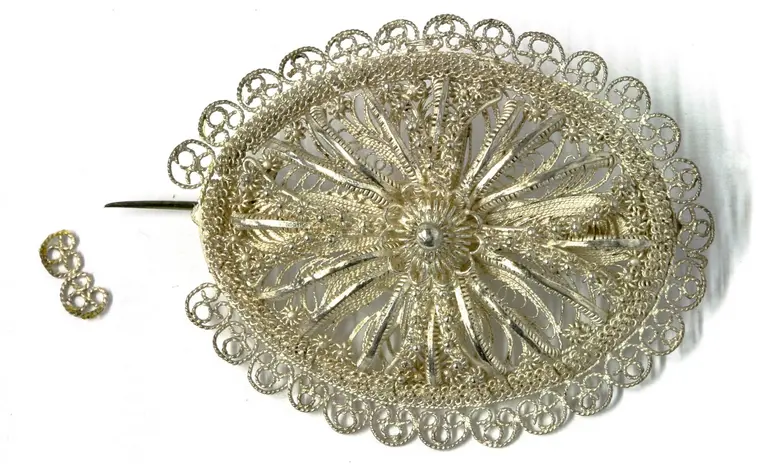
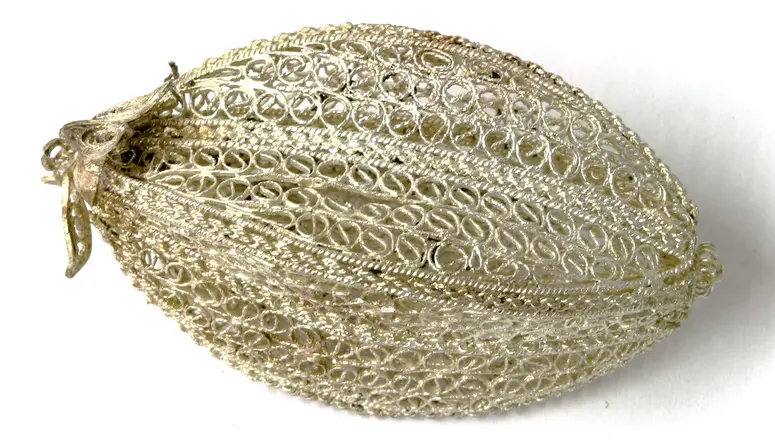
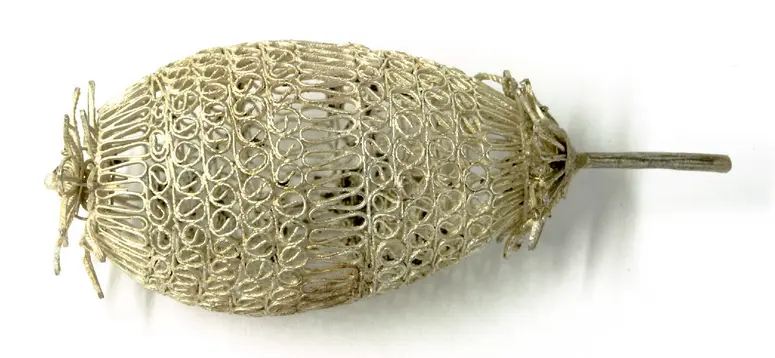
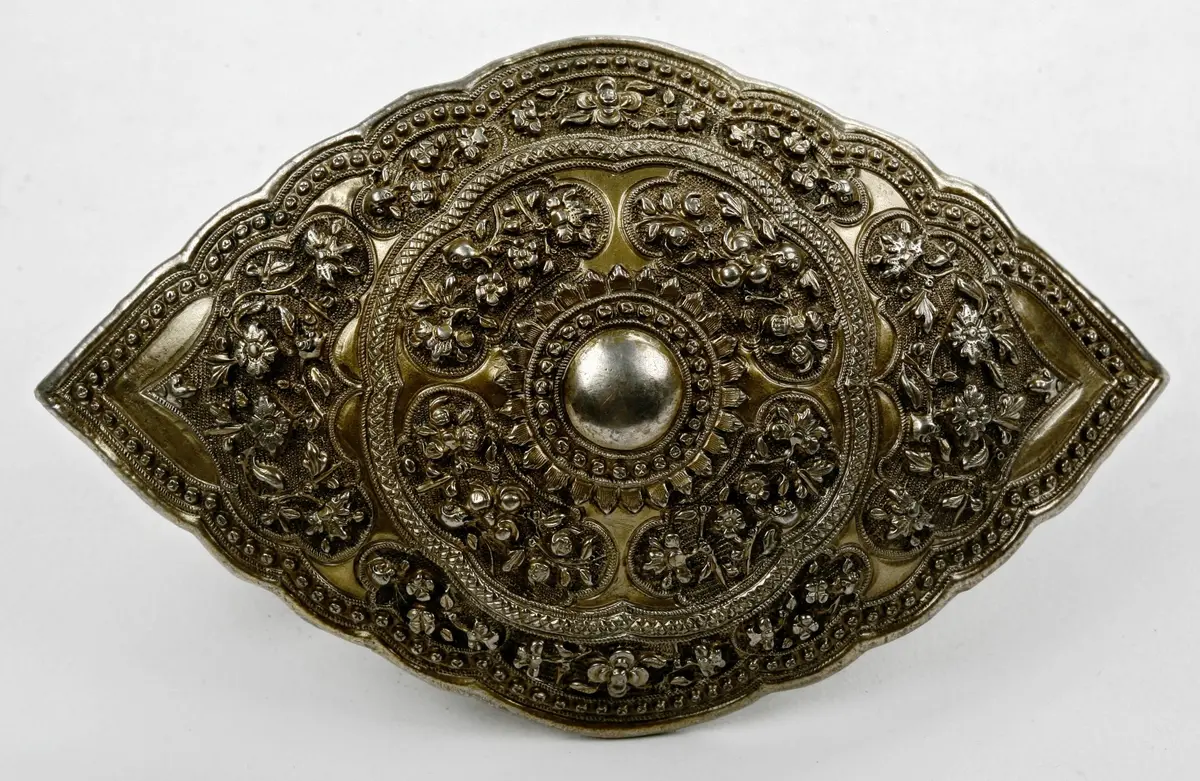
Note: The following text is taken from a 19th-century collection catalog and, in its language and perspective, partially reflects colonial thought patterns. We present the text in its original version to make the collection's history transparent and promote a critical examination of the colonial legacy. Certain terms and formulations may be perceived as problematic today. A 2009 research project concluded that most descriptions are factually correct and still usable; only a few details were found to be inaccurate or incorrect. The results of this project were published in the following collection catalog: khm-wmw-tm-library.on.worldcat.org/oclc/1457155265"711. Belt plateA large, diamond-shaped plate of silver, very richly and artfully chased, intended for a belt, as men like to wear. Jewellery plays an important role for all peoples in the Indian Archipelago, loved by both men and women with the same passion and primarily the diamond "intan" represents the ideal for every native. The people will give everything for jewellery and one often sees people dressed in the shabbiest manner wearing expensive earrings, pins and belts. All these different and expensive pieces of jewellery are made in large quantities either by the natives themselves or by Chinese or Arab goldsmiths, who can be found in every larger place. The passionate love of jewellery, diamonds and actually everything which is shiny has spread and been inherited by the women of mixed blood as well, yes, even more: all women born in India, and even those of pure European heritage share this passion with their brown sisters. One sees in simple families mother and daughter adorned with jewellery which costs many thousands. All the gold and silver craftsmen, both the natives and the Chinese and Arabs are very skilful and produce true works of art; they are respected everywhere as a special class and celebrated. In some areas it is the relatives of the ruling nobles who occupy themselves with this work. The craft of the gold and silversmiths is an honourable one, just as is that of the armourer. The chasing of the thin metal plates is done in the simplest of ways. The artisan presses the metal plate onto a semi-soft cake of resin and pushes out the design with a metal rod in the negative onto the plate; the positive design is found, of course, on the side where the resin cake is.The Arabs, who import cut gems in large numbers all over the archipelago, are sharp experts in stones and are seldom deceived, however they cheat the naive natives out of their savings in the most shameless way."Translation of: Czurda, F. A. J. (1883). Catalog mit Erklärungen der Etnografischen Privatsammlung des Dr. F. A. J. Czurda in Postelberg (Böhmen). (p. 166-167). Wien, Wilhelm Braumüller
Note: The following text is taken from a 19th-century collection catalog and, in its language and perspective, partially reflects colonial thought patterns. We present the text in its original version to make the collection's history transparent and promote a critical examination of the colonial legacy. Certain terms and formulations may be perceived as problematic today. A 2009 research project concluded that most descriptions are factually correct and still usable; only a few details were found to be inaccurate or incorrect. The results of this project were published in the following collection catalog: khm-wmw-tm-library.on.worldcat.org/oclc/1457155265"711. Belt plateA large, diamond-shaped plate of silver, very richly and artfully chased, intended for a belt, as men like to wear. Jewellery plays an important role for all peoples in the Indian Archipelago, loved by both men and women with the same passion and primarily the diamond "intan" represents the ideal for every native. The people will give everything for jewellery and one often sees people dressed in the shabbiest manner wearing expensive earrings, pins and belts. All these different and expensive pieces of jewellery are made in large quantities either by the natives themselves or by Chinese or Arab goldsmiths, who can be found in every larger place. The passionate love of jewellery, diamonds and actually everything which is shiny has spread and been inherited by the women of mixed blood as well, yes, even more: all women born in India, and even those of pure European heritage share this passion with their brown sisters. One sees in simple families mother and daughter adorned with jewellery which costs many thousands. All the gold and silver craftsmen, both the natives and the Chinese and Arabs are very skilful and produce true works of art; they are respected everywhere as a special class and celebrated. In some areas it is the relatives of the ruling nobles who occupy themselves with this work. The craft of the gold and silversmiths is an honourable one, just as is that of the armourer. The chasing of the thin metal plates is done in the simplest of ways. The artisan presses the metal plate onto a semi-soft cake of resin and pushes out the design with a metal rod in the negative onto the plate; the positive design is found, of course, on the side where the resin cake is.The Arabs, who import cut gems in large numbers all over the archipelago, are sharp experts in stones and are seldom deceived, however they cheat the naive natives out of their savings in the most shameless way."Translation of: Czurda, F. A. J. (1883). Catalog mit Erklärungen der Etnografischen Privatsammlung des Dr. F. A. J. Czurda in Postelberg (Böhmen). (p. 166-167). Wien, Wilhelm Braumüller
Collector:
František A. J. Czurda (1844 Pisek - 1886 Cirebon) DNB
Entry Date:
1883
Object Name
Belt disc
Culture
West-Java
Material/technology:
Silver; chased
Copyright
Weltmuseum Wien
Collection area
Insular Southeast Asia
Invs.
18039