Gong
Gong
Note: The following text is taken from a 19th-century collection catalog and, in its language and perspective, partially reflects colonial thought patterns. We present the text in its original version to make the collection's history transparent and promote a critical examination of the colonial legacy. Certain terms and formulations may be perceived as problematic today. A 2009 research project concluded that most descriptions are factually correct and still usable; only a few details were found to be inaccurate or incorrect. The results of this project were published in the following collection catalog: khm-wmw-tm-library.on.worldcat.org/oclc/1457155265"445. Metal cymbal - "Gong"A large metal cymbal of brass, not made in the country but rather imported from China which is found all over the Indian Archipelago. On Java it is made in all sizes by the Javanese and it amounts to the main instrument of their national orchestra, which is known as "gamelang". It is used in different ways. As a musical instrument to strike the beat by striking it with a drumstick of wood which has been covered with leather and rattan, or hung in front of the mosque, to call to prayer, when necessary also used to frighten away devils and evil spirits, and finally used by the fishermen on their boats to advise their relatives on the coast of their departure and arrival. Every fishing boat has its own gong on board and each fisherman knows how to hit it so that his relatives can tell from far away that he will be arriving. At festivities and large celebrations, a large number of such gongs are hit in the most terrible manner, and its music is accompanied by the natives' monotonous cries. Such a concert can go on for hours without the musicians or the public tiring."Translation of: Czurda, F. A. J. (1883). Catalog mit Erklärungen der Etnografischen Privatsammlung des Dr. F. A. J. Czurda in Postelberg (Böhmen). (p. 103). Wien, Wilhelm Braumüller
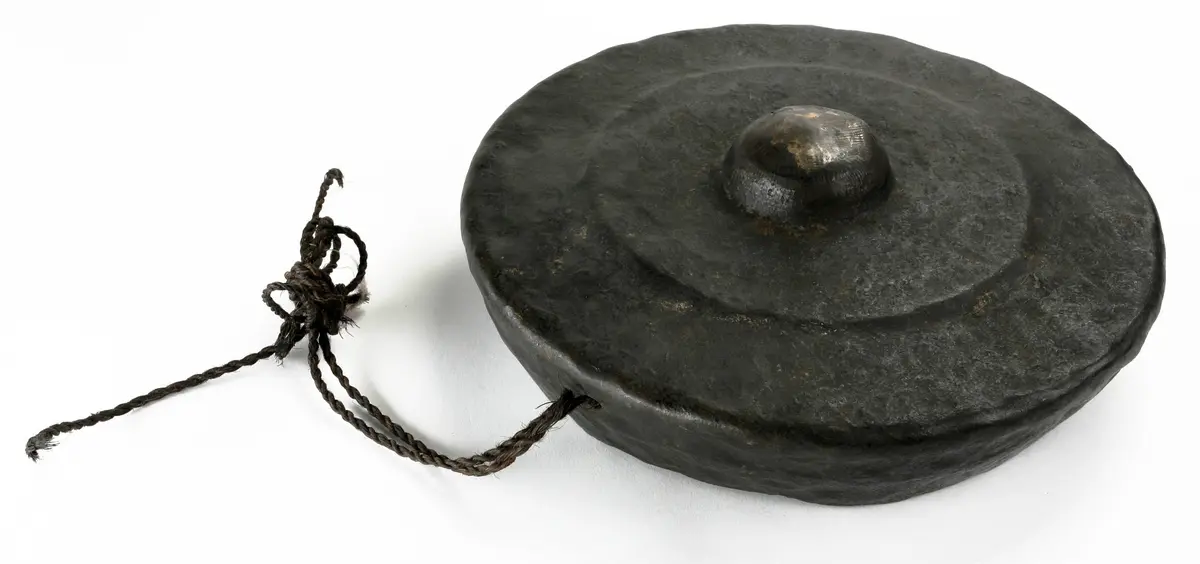
Note: The following text is taken from a 19th-century collection catalog and, in its language and perspective, partially reflects colonial thought patterns. We present the text in its original version to make the collection's history transparent and promote a critical examination of the colonial legacy. Certain terms and formulations may be perceived as problematic today. A 2009 research project concluded that most descriptions are factually correct and still usable; only a few details were found to be inaccurate or incorrect. The results of this project were published in the following collection catalog: khm-wmw-tm-library.on.worldcat.org/oclc/1457155265"445. Metal cymbal - "Gong"A large metal cymbal of brass, not made in the country but rather imported from China which is found all over the Indian Archipelago. On Java it is made in all sizes by the Javanese and it amounts to the main instrument of their national orchestra, which is known as "gamelang". It is used in different ways. As a musical instrument to strike the beat by striking it with a drumstick of wood which has been covered with leather and rattan, or hung in front of the mosque, to call to prayer, when necessary also used to frighten away devils and evil spirits, and finally used by the fishermen on their boats to advise their relatives on the coast of their departure and arrival. Every fishing boat has its own gong on board and each fisherman knows how to hit it so that his relatives can tell from far away that he will be arriving. At festivities and large celebrations, a large number of such gongs are hit in the most terrible manner, and its music is accompanied by the natives' monotonous cries. Such a concert can go on for hours without the musicians or the public tiring."Translation of: Czurda, F. A. J. (1883). Catalog mit Erklärungen der Etnografischen Privatsammlung des Dr. F. A. J. Czurda in Postelberg (Böhmen). (p. 103). Wien, Wilhelm Braumüller
Collector:
František A. J. Czurda (1844 Pisek - 1886 Cirebon) DNB
Entry Date:
1883
Object Name
Gong
Culture
Süd-Sulawesi
Material/technology:
Iron
Copyright
Weltmuseum Wien
Collection area
Insular Southeast Asia
Geography
Insulares Südostasien
Invs.
17690
Browse more Similar items you might be interested in


Der Alltag auf Nikobaren: : Fischreuse, Körbchen, Zählholz, Fächer, Scheidewand Edward Horace Man 1888