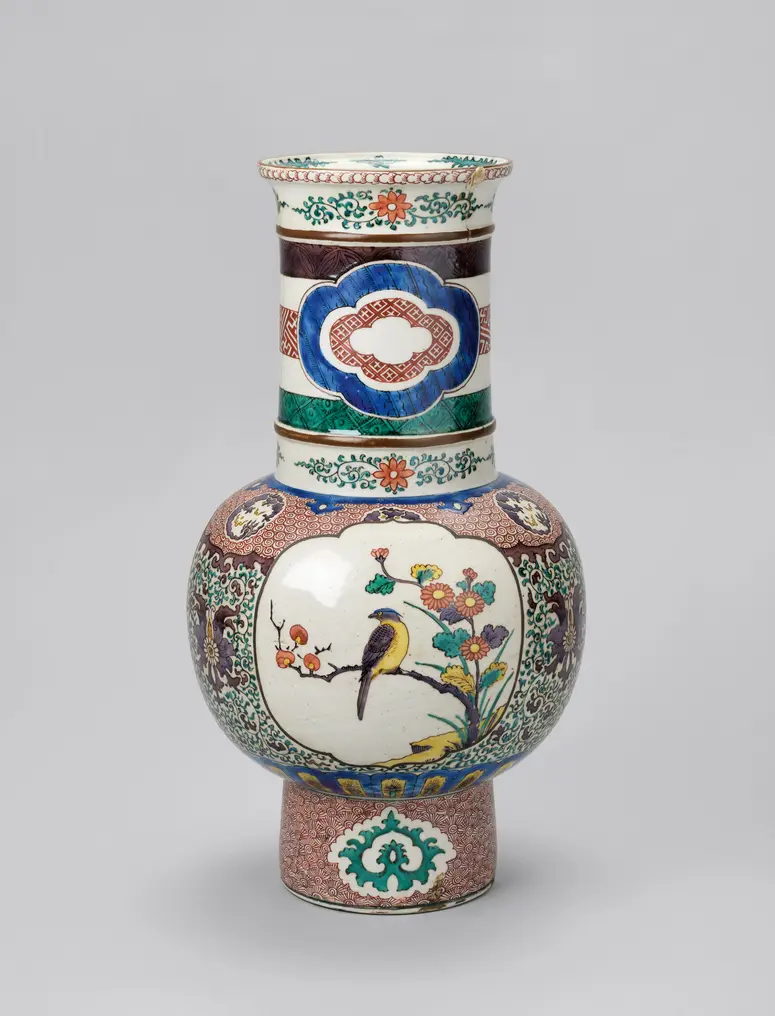
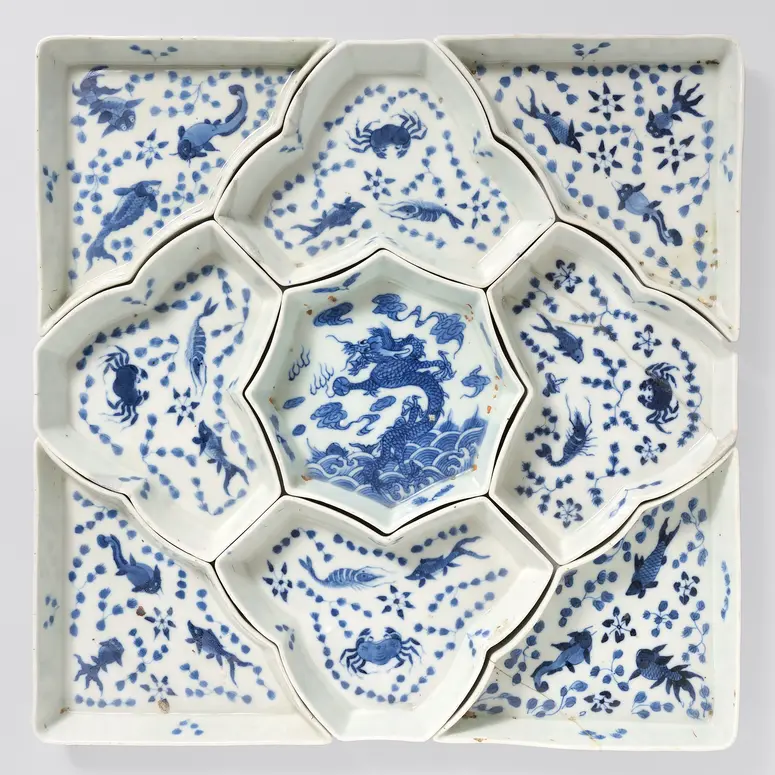
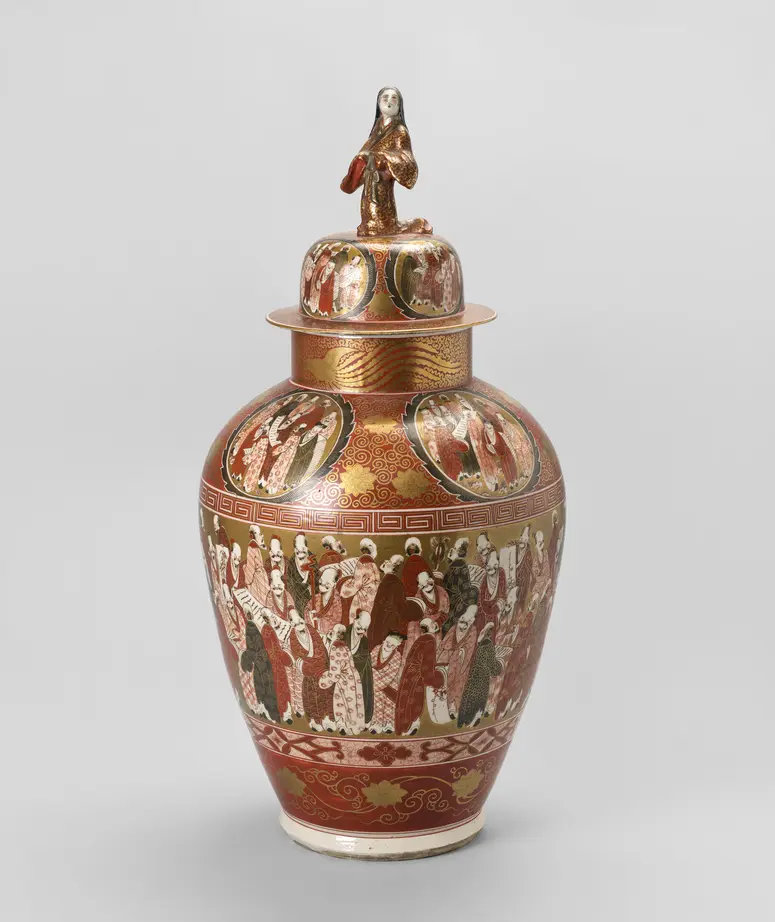
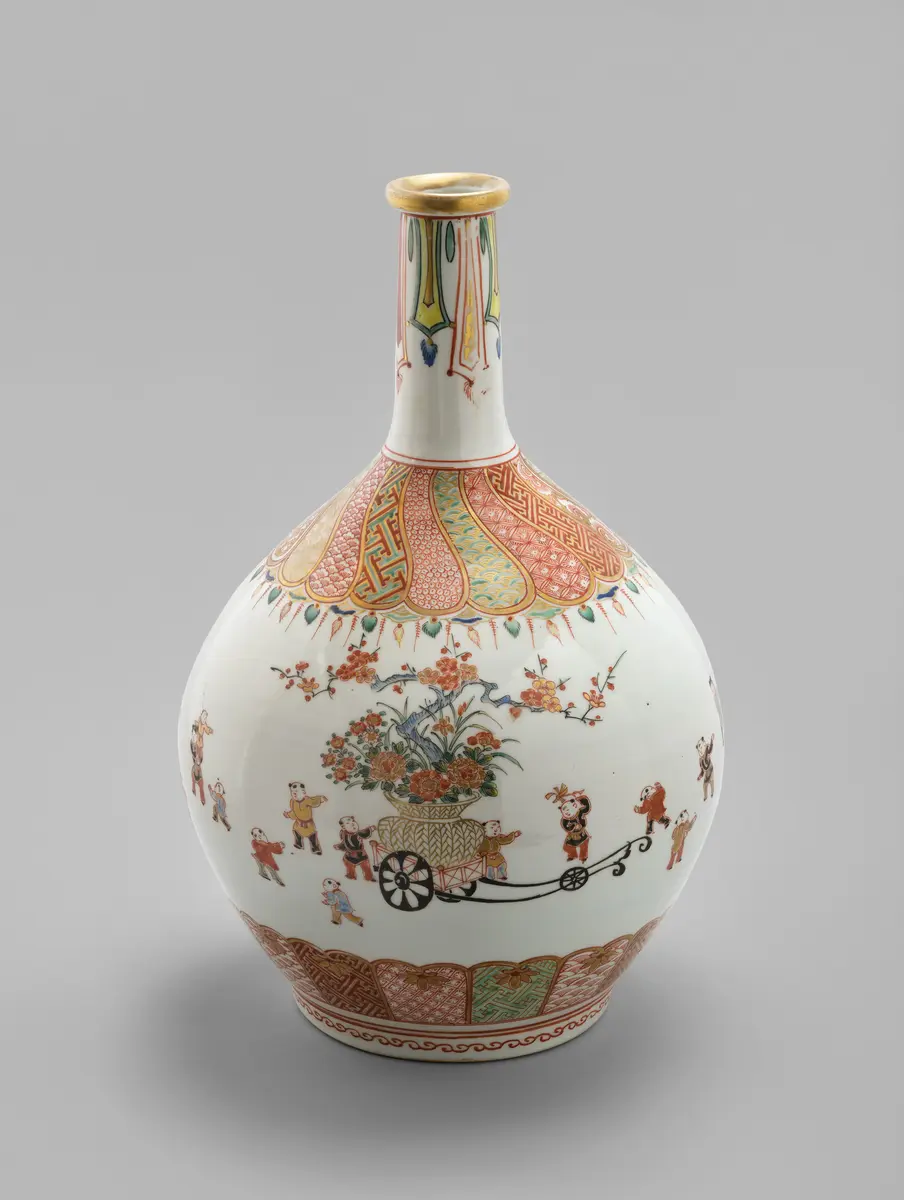
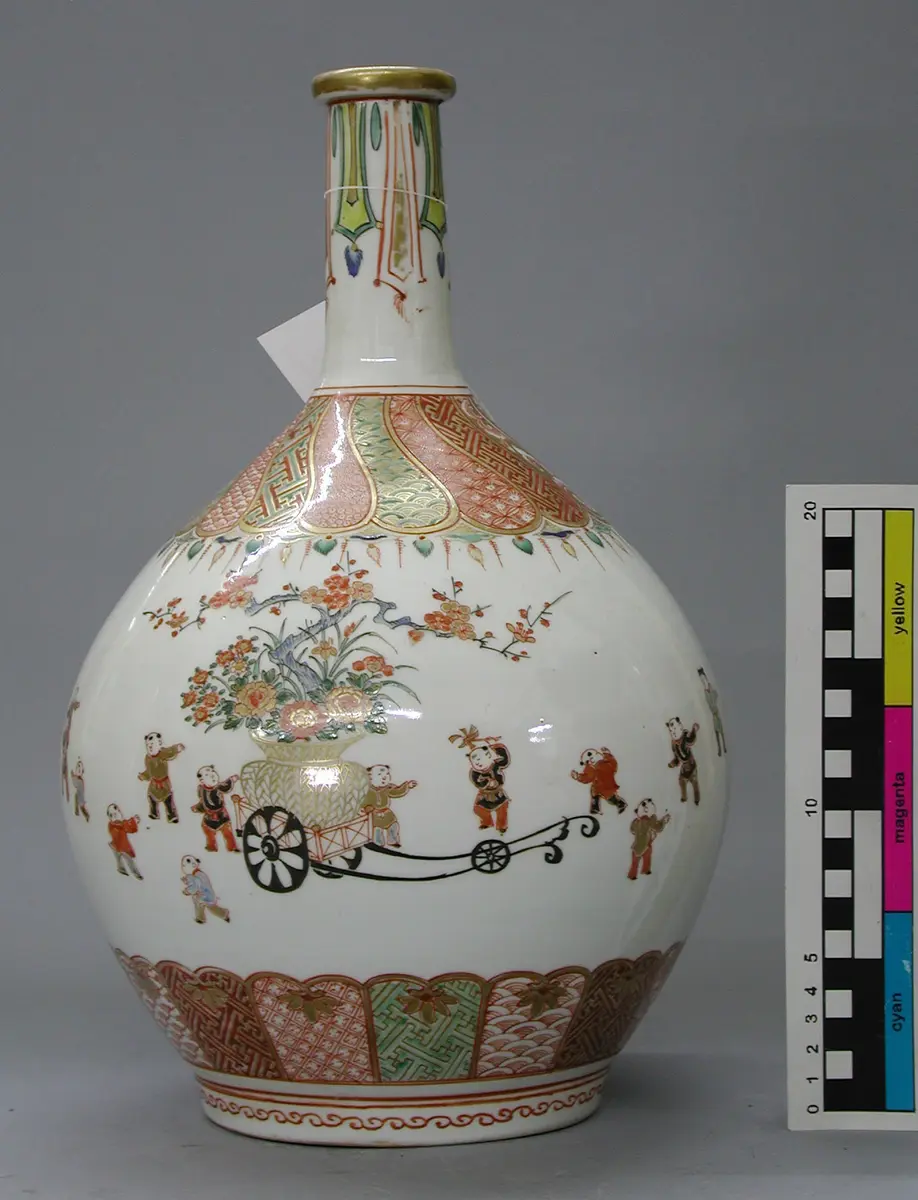
This a richly colored large vase with a bulging body. The production of such vases flourished during the eighteenth century (mid-Edo period) at Hizen kilns in Kyushu. This work was probably a revival of this style created for overseas export during the middle to second half of the 19th century (first half of the Meiji period). On the body we find a resplendent flower cart being pulled by cute children in Chinese clothing. On the neck of the vase we find a bead/lace-work string (yōraku) pattern. At the base of the neck is a geometrically patterned swirling floral design, from which hangs another bead/lace-work string pattern. At the bottom part of the vase’s body is a lotus petal pattern, which is also filled with geometrical patterns. Masaki ARAKAWA
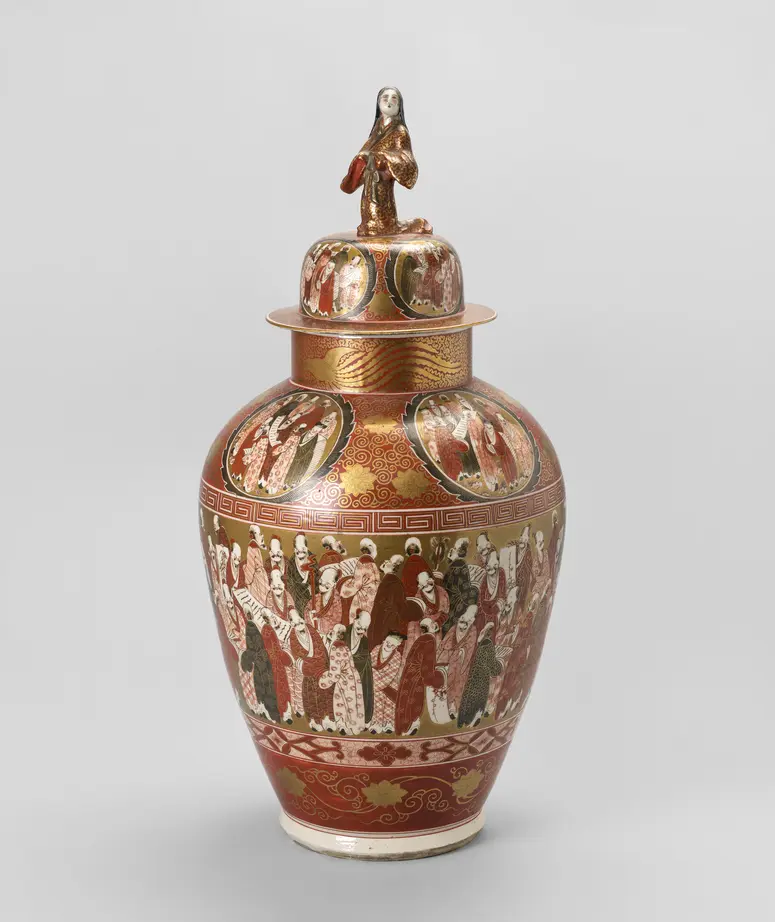
This a richly colored large vase with a bulging body. The production of such vases flourished during the eighteenth century (mid-Edo period) at Hizen kilns in Kyushu. This work was probably a revival of this style created for overseas export during the middle to second half of the 19th century (first half of the Meiji period). On the body we find a resplendent flower cart being pulled by cute children in Chinese clothing. On the neck of the vase we find a bead/lace-work string (yōraku) pattern. At the base of the neck is a geometrically patterned swirling floral design, from which hangs another bead/lace-work string pattern. At the bottom part of the vase’s body is a lotus petal pattern, which is also filled with geometrical patterns. Masaki ARAKAWA
Collector:
Heinrich von Siebold (1852 St. Martin/Boppard - 1908 Schloss Freudenstein/Bozen) DNB
Material/technology:
Porcelain
Dimensions:
H: 35 cm
D: 22.2 cm
Copyright
Weltmuseum Wien
Collection area
East Asia: China, Korea, Japan
Geography
Ostasien/Japan
Invs.
34738