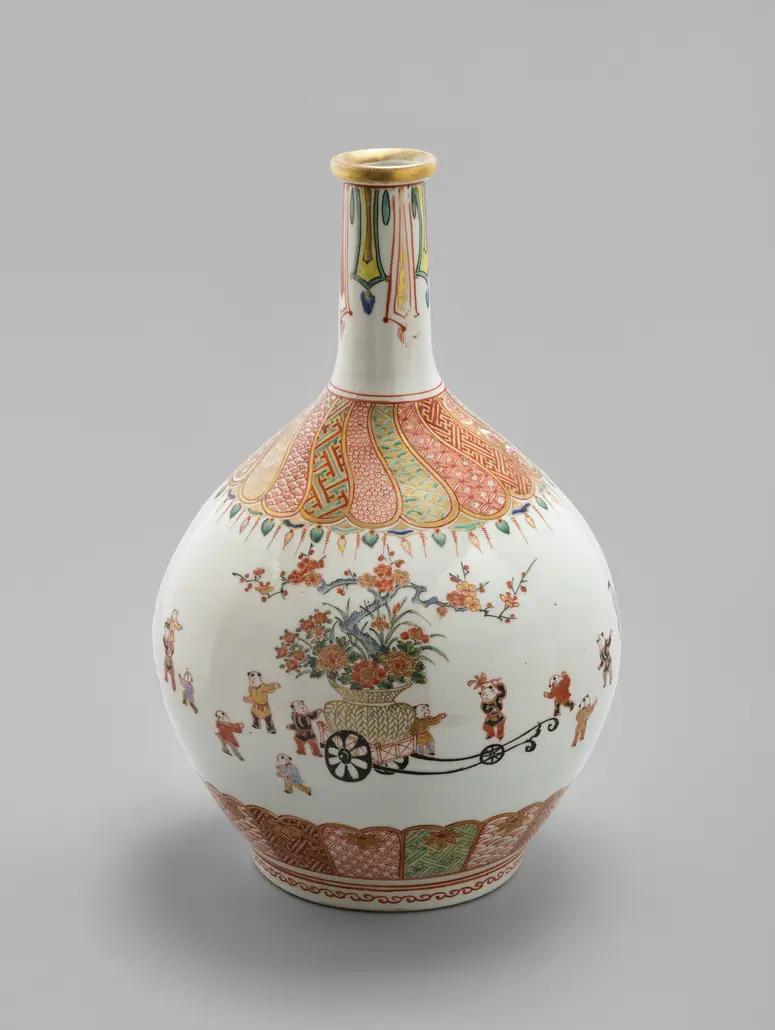
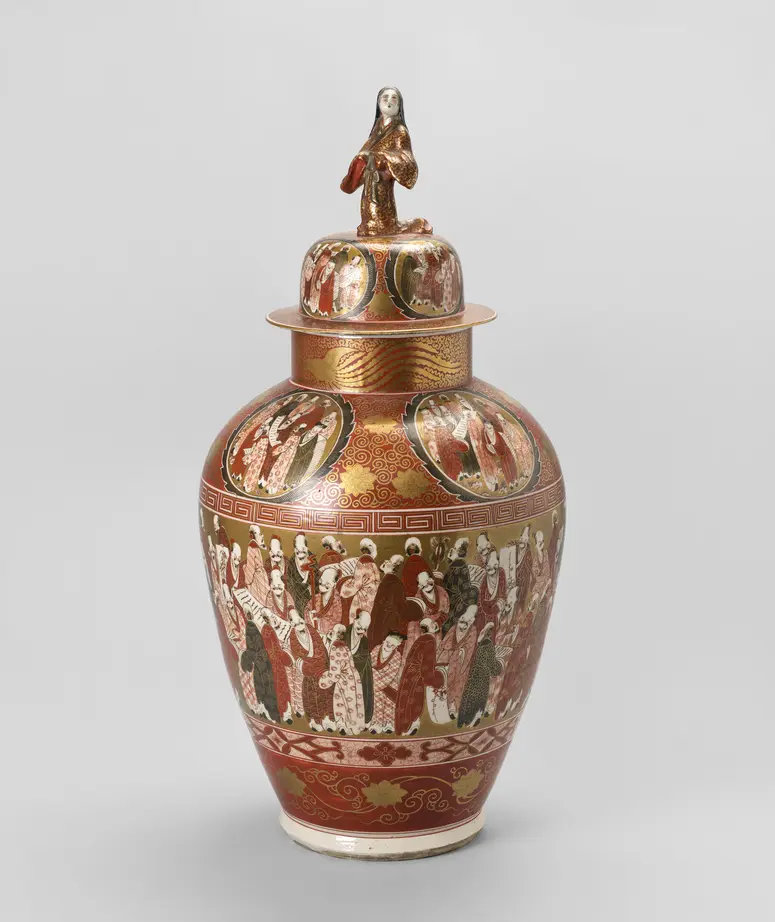
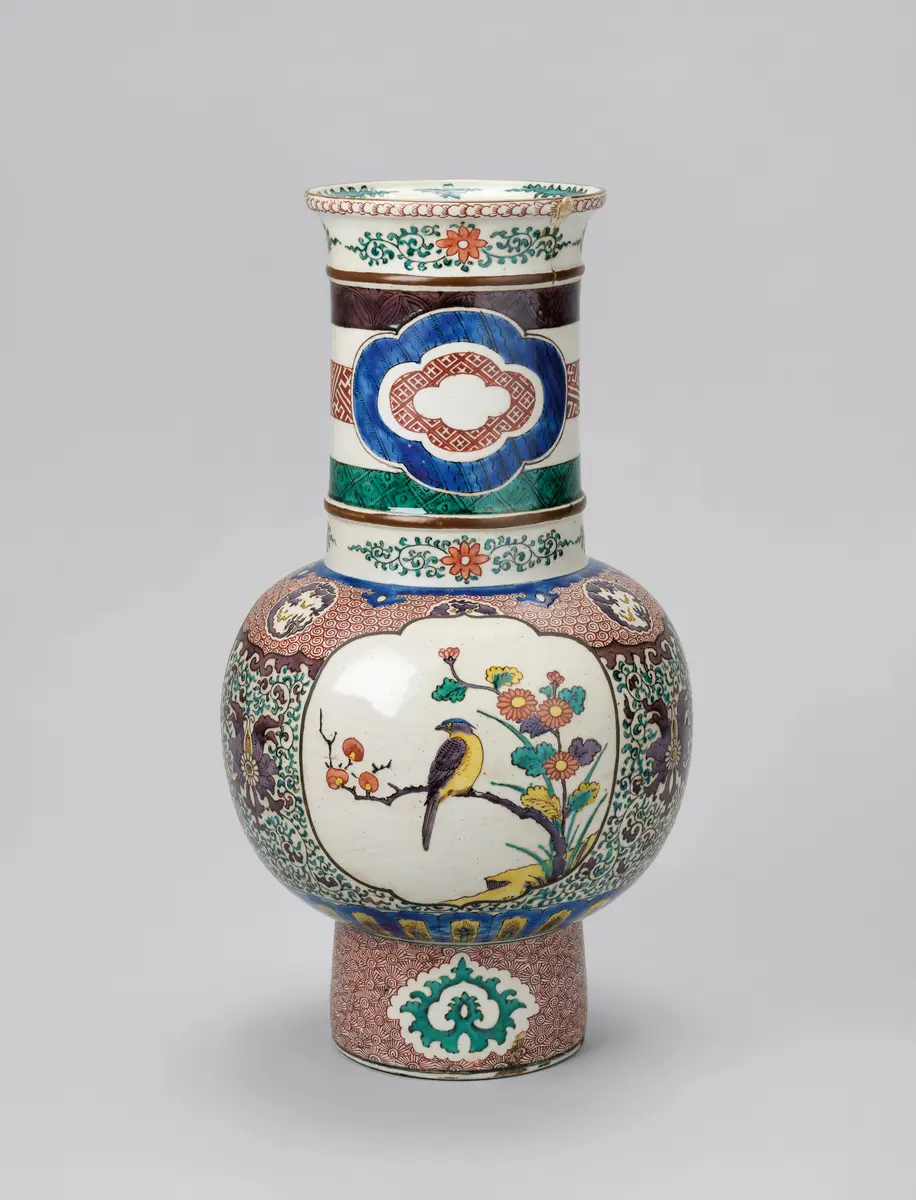
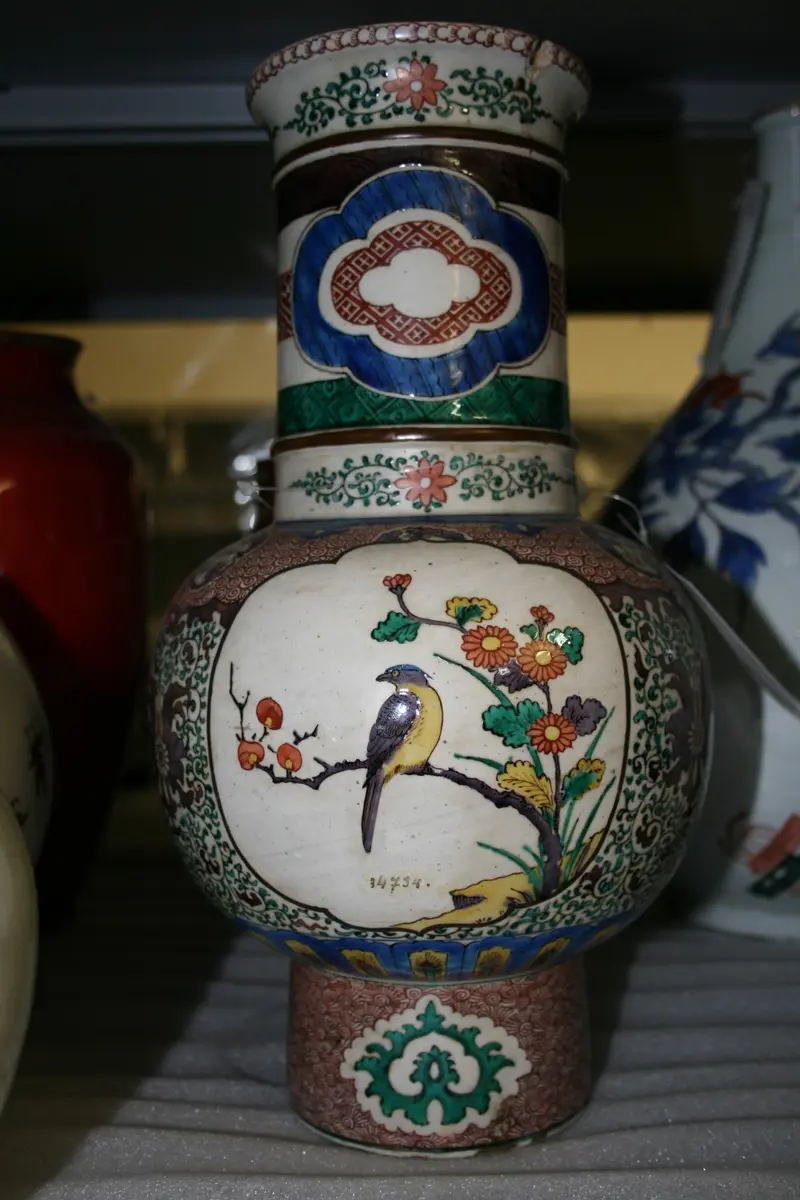
This elegant work features a gorgeous design applied in detail. It appears to be Kutani ware from Ishikawa Prefecture created around the 1880s. It is modeled after the seventeenth century classic style called “Ko-kutani.” For many years from the second half of the Edo period onwards, Ko-kutani products were thought to have been produced at the Kutani kiln in the Saga domain's Yamanaka area (today, Kaga city, Ishikawa prefecture). This is referred to as the “Ko-kutani” Kaga theory. However, archeological surveys carried out from the 1970s onwards in the Hizen Arita area in Kyushu basically made clear that such products were made at Hizen / Arita kilns during the mid-sventeenth century. This is referred to as the “Ko-kutani” Arita theory. This piece was created when the Ko-kutani Saga theory was predominant. It was modeled after a five-colored Ko-kutani work actually produced in the 1640s at an Arita kiln. While almost all Ko-kutani were large plates, this piece is a flower vase and includes a classy Ko-kutani design on its front. Masaki ARAKAWA
This elegant work features a gorgeous design applied in detail. It appears to be Kutani ware from Ishikawa Prefecture created around the 1880s. It is modeled after the seventeenth century classic style called “Ko-kutani.” For many years from the second half of the Edo period onwards, Ko-kutani products were thought to have been produced at the Kutani kiln in the Saga domain's Yamanaka area (today, Kaga city, Ishikawa prefecture). This is referred to as the “Ko-kutani” Kaga theory. However, archeological surveys carried out from the 1970s onwards in the Hizen Arita area in Kyushu basically made clear that such products were made at Hizen / Arita kilns during the mid-sventeenth century. This is referred to as the “Ko-kutani” Arita theory. This piece was created when the Ko-kutani Saga theory was predominant. It was modeled after a five-colored Ko-kutani work actually produced in the 1640s at an Arita kiln. While almost all Ko-kutani were large plates, this piece is a flower vase and includes a classy Ko-kutani design on its front. Masaki ARAKAWA
Collector:
Heinrich von Siebold (1852 St. Martin/Boppard - 1908 Schloss Freudenstein/Bozen) DNB
Dimensions:
H: 36.0 cm
D: 18.5 cm
Copyright
Weltmuseum Wien
Collection area
East Asia: China, Korea, Japan
Geography
Ostasien/Japan
Invs.
34734