This appears to have been created in the White Satsuma style (clear glaze applied to the clay body). However, the material has small cracks, which one does not generally find on colored White Satsuma ware. Therefore, it is hard to definitively determine where it was produced. On the body of this small bowl are gorgeous three-dimensional plum blossoms, resembling a sculpture. Plum tree branches hang down from its opening. Then appear swelling buds, and, finally, gorgeous blooming flowers. The buds are a light pink, the young leaves a light green, and the flower stamina / pistils gold. The plum flowers are not fully bloomed. Rather, the piece seems to be rendering a plum tree that is just about to bloom, with the buds coming open one after another and the flower petals opening up bit by bit. We could describe it as a refreshing vessel filled with the power of life. Around its opening and bottom are gold bands. This is probably an imitation of the neo-classicist style that was popular in the West during the nineteenth century. Masaki ARAKAWA

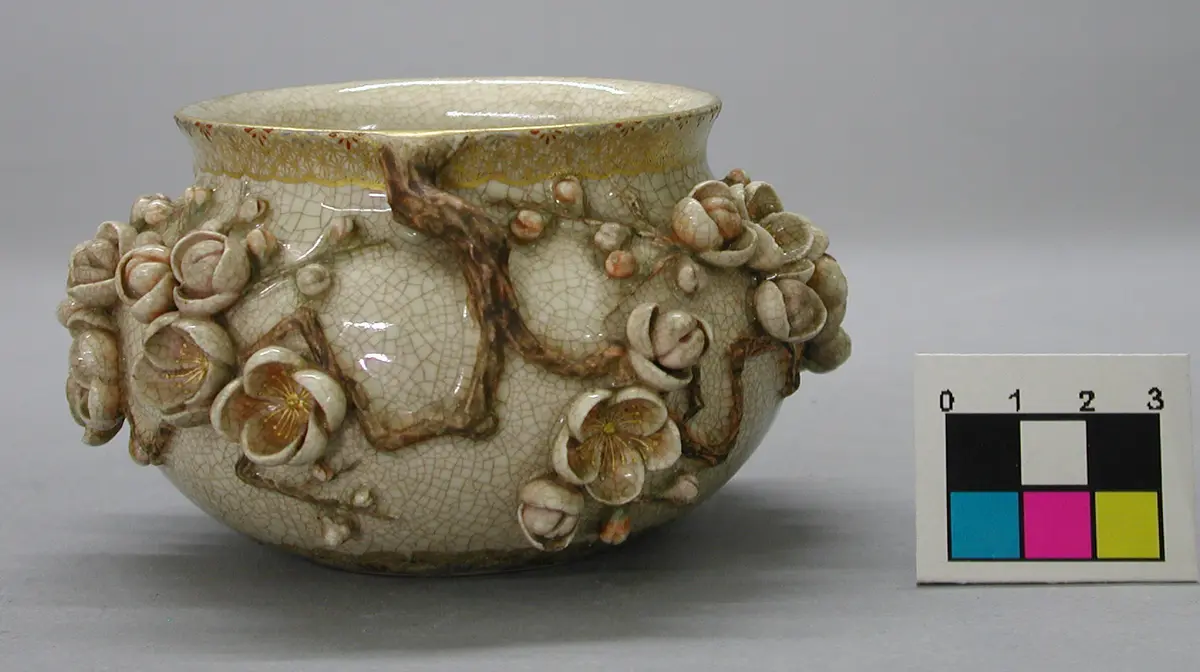
This appears to have been created in the White Satsuma style (clear glaze applied to the clay body). However, the material has small cracks, which one does not generally find on colored White Satsuma ware. Therefore, it is hard to definitively determine where it was produced. On the body of this small bowl are gorgeous three-dimensional plum blossoms, resembling a sculpture. Plum tree branches hang down from its opening. Then appear swelling buds, and, finally, gorgeous blooming flowers. The buds are a light pink, the young leaves a light green, and the flower stamina / pistils gold. The plum flowers are not fully bloomed. Rather, the piece seems to be rendering a plum tree that is just about to bloom, with the buds coming open one after another and the flower petals opening up bit by bit. We could describe it as a refreshing vessel filled with the power of life. Around its opening and bottom are gold bands. This is probably an imitation of the neo-classicist style that was popular in the West during the nineteenth century. Masaki ARAKAWA
Collector:
Heinrich von Siebold (1852 St. Martin/Boppard - 1908 Schloss Freudenstein/Bozen) DNB
Material/technology:
Ceramic
Dimensions:
H: 7.0 cm
D: 11.5 cm
Copyright
Weltmuseum Wien
Collection area
East Asia: China, Korea, Japan
Geography
Ostasien/Japan
Invs.
34731