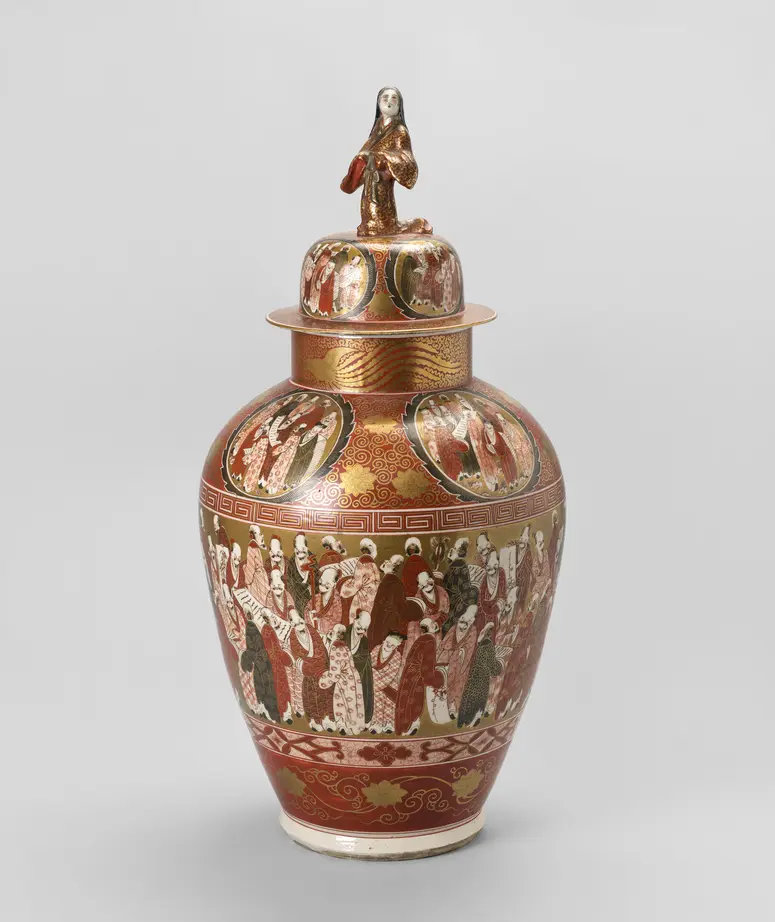
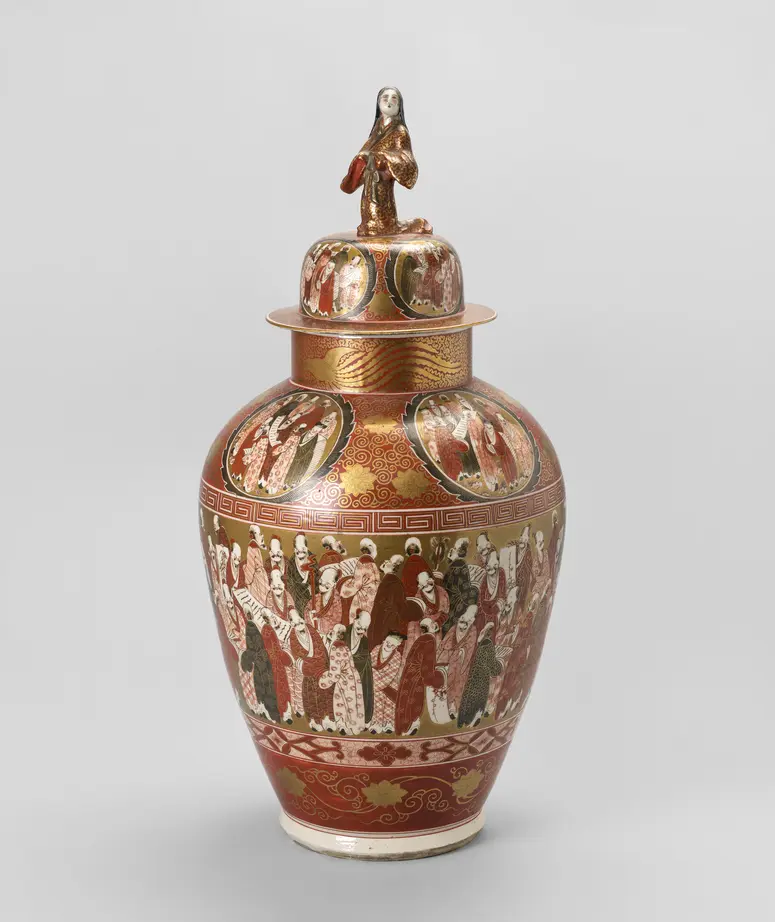
While one finds the base inscription “Kenzan,” judging from the inscription’s characteristics and the pattern design, this work does not appear to be by Ogata Kenzan (1663–1743) himself. Probably created during the middle or latter half of the nineteenth century it is imitating Kenzan’s style. On the body of this piece we find a so-called thirty-six immortals of poetry (sanjūrokkasen) image. The thirty-six immortals of poetry were chosen by the tenth century / mid-Heian period poet Fujiwara no Kintō. Images of them were often created during the Kamakura period (1182–1333) and later. Ogata Kōrin (1658–1716), the biological brother of Kenzan, revived this image during the middle of the Edo period (1600–1868). He transformed it, depicting poets that lived in different eras as if they were participating in a poetry gathering. The Edo Rinpa school painters Sakai Hōitsu (1761–1829) and Suzuki Kiitsu (1796–1858) popularized this Kōrin-style “thirty-six immortals of poetry” image during the latter half of the Edo period. It appears that ceramic works like this one were under the influence of this popular Edo Rinpa version. Masaki ARAKAWA
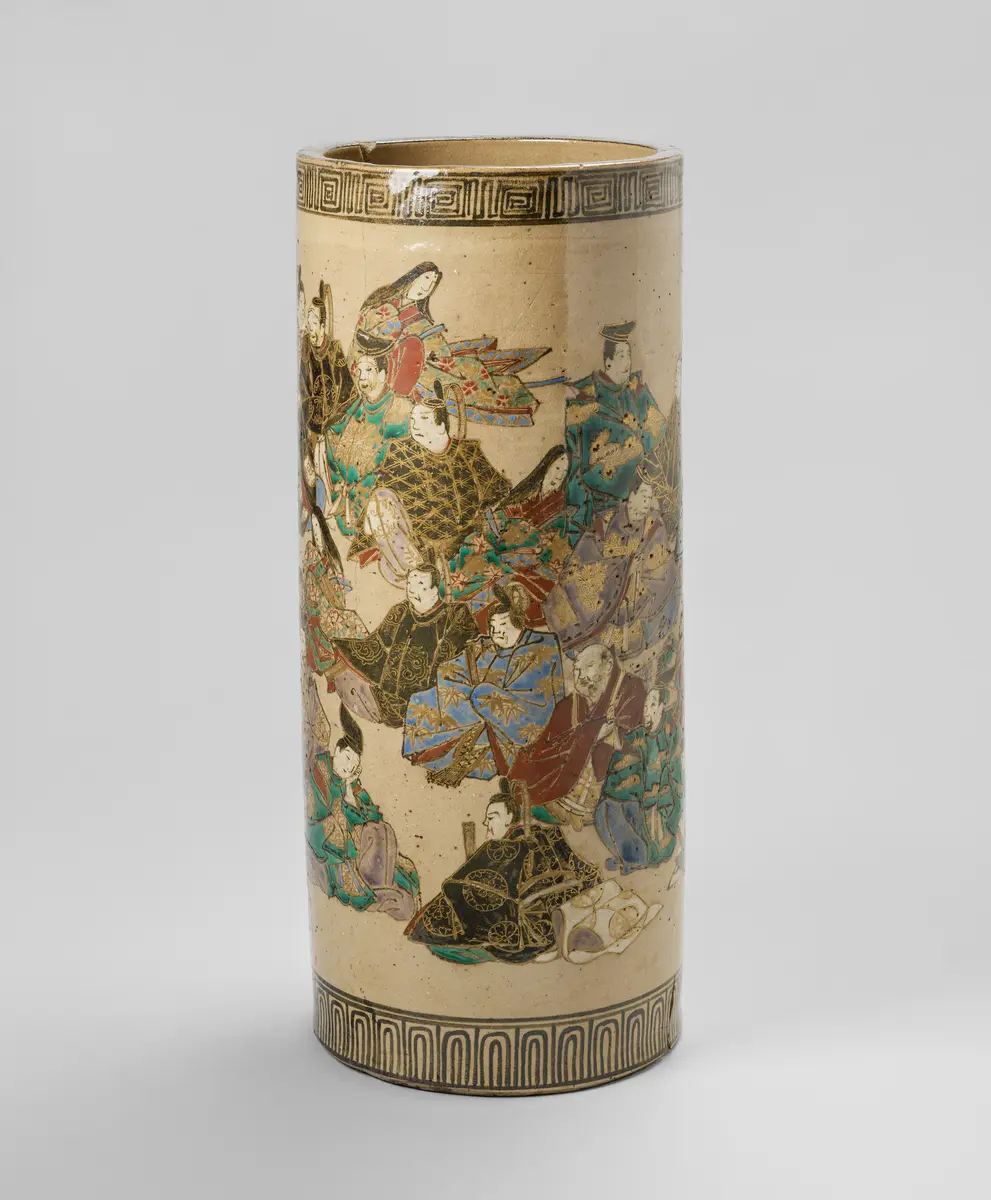
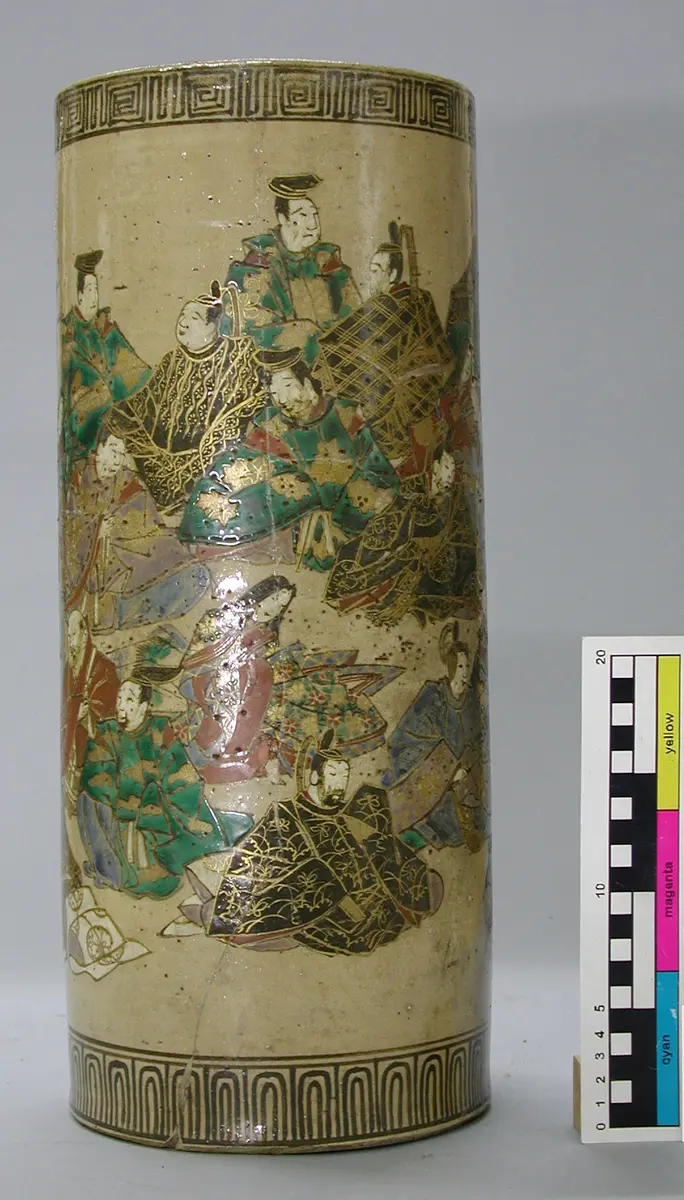
While one finds the base inscription “Kenzan,” judging from the inscription’s characteristics and the pattern design, this work does not appear to be by Ogata Kenzan (1663–1743) himself. Probably created during the middle or latter half of the nineteenth century it is imitating Kenzan’s style. On the body of this piece we find a so-called thirty-six immortals of poetry (sanjūrokkasen) image. The thirty-six immortals of poetry were chosen by the tenth century / mid-Heian period poet Fujiwara no Kintō. Images of them were often created during the Kamakura period (1182–1333) and later. Ogata Kōrin (1658–1716), the biological brother of Kenzan, revived this image during the middle of the Edo period (1600–1868). He transformed it, depicting poets that lived in different eras as if they were participating in a poetry gathering. The Edo Rinpa school painters Sakai Hōitsu (1761–1829) and Suzuki Kiitsu (1796–1858) popularized this Kōrin-style “thirty-six immortals of poetry” image during the latter half of the Edo period. It appears that ceramic works like this one were under the influence of this popular Edo Rinpa version. Masaki ARAKAWA
Collector:
Heinrich von Siebold (1852 St. Martin/Boppard - 1908 Schloss Freudenstein/Bozen) DNB
Material/technology:
Ceramic
Dimensions:
H: 44.3 cm
D: 18.0 cm
Copyright
Weltmuseum Wien
Collection area
East Asia: China, Korea, Japan
Geography
Ostasien/Japan
Invs.
34739