Dakshina Kali
20th century | Günther Jontes
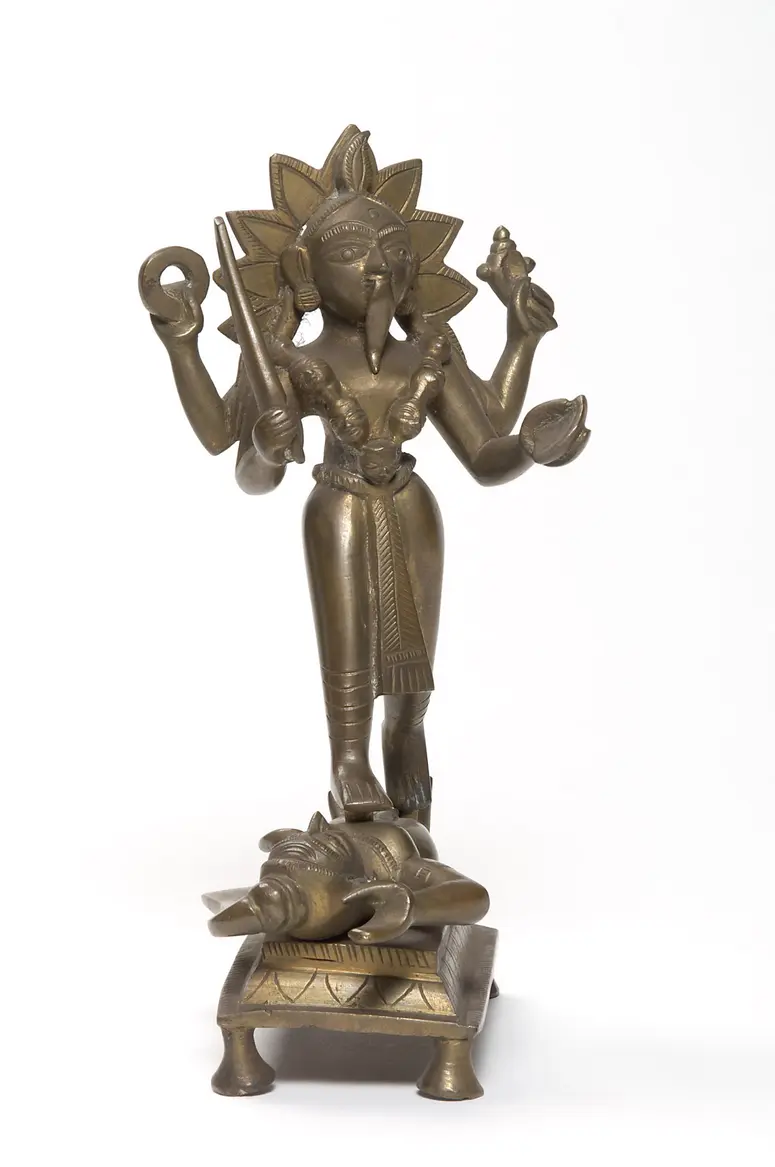
One aspect of the mother goddess is bloodthirsty, violent and sinister, often depicted standing victorious on the battlefield or cremation ground, with various weapons in her many arms, necklace of human skulls, red tongue hanging out and large fangs. In this picture, Kāli stands in a triumphant posture on the prostrate Śiva. If the scene is depicted on a cremation ground, it is about the great destruction of the world, whereby at the end of an era the entire cosmos is absorbed into Vishnu or Kali in order to then create the world anew. With this destructive act, Kali is equated with Shiva. Here, however, a battlefield appears where Kali once became intoxicated with the blood of her victims and began to dance out of control, threatening the world. Shiva lay down on the ground to make her stop. According to the myth, Kali stopped dancing, but the iconography depicts her as uncontrollable and triumphant over Shiva. The third story ends the same way, only it is a dance competition between Kali and Shiva.
Such printed images of devī appeared in the last quarter of the 19th century in Bengal, first with woodblock, lithography, oil printing then multiplied with modern printing techniques, often in a "devotional pin-up style". Mass production of such posters meant commercialization of religion, and became a marketing tool. However, these images express orthodox thinking to this day, and remain within the Hindu iconographic tradition
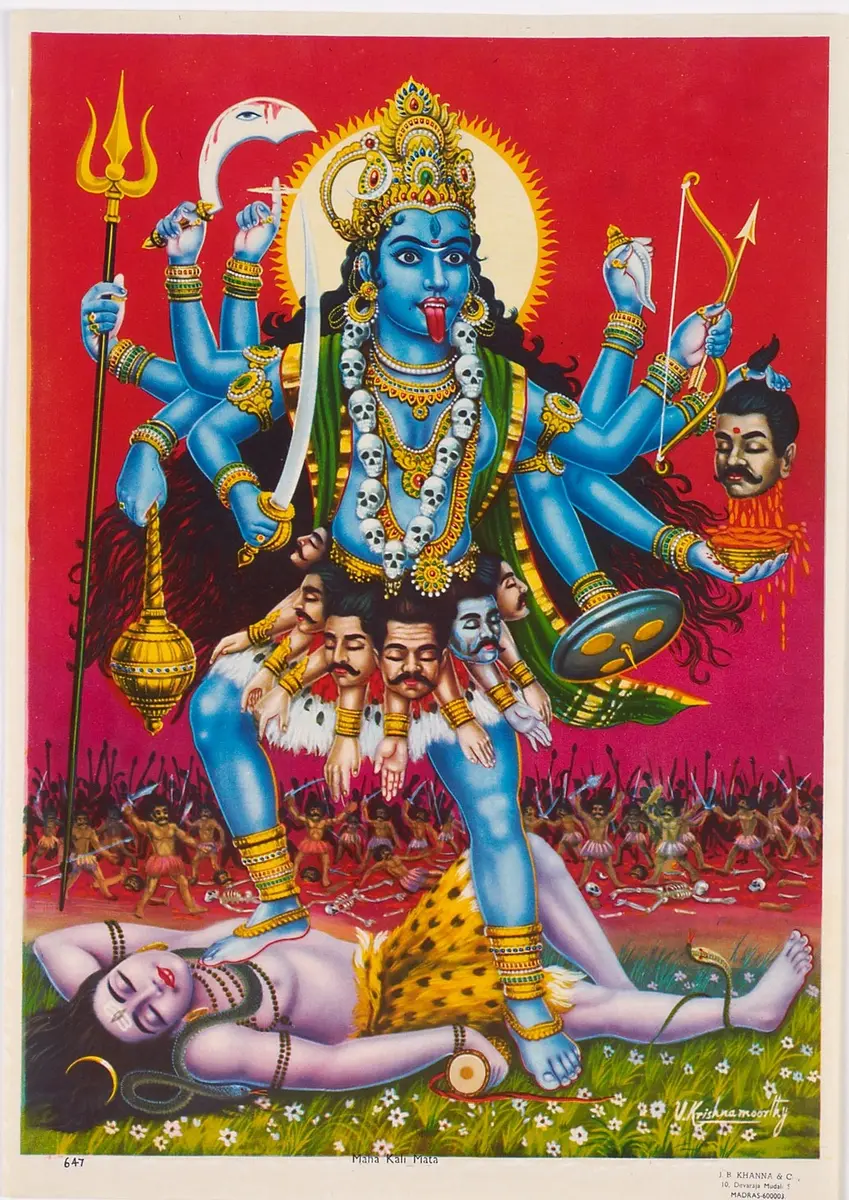
One aspect of the mother goddess is bloodthirsty, violent and sinister, often depicted standing victorious on the battlefield or cremation ground, with various weapons in her many arms, necklace of human skulls, red tongue hanging out and large fangs. In this picture, Kāli stands in a triumphant posture on the prostrate Śiva. If the scene is depicted on a cremation ground, it is about the great destruction of the world, whereby at the end of an era the entire cosmos is absorbed into Vishnu or Kali in order to then create the world anew. With this destructive act, Kali is equated with Shiva. Here, however, a battlefield appears where Kali once became intoxicated with the blood of her victims and began to dance out of control, threatening the world. Shiva lay down on the ground to make her stop. According to the myth, Kali stopped dancing, but the iconography depicts her as uncontrollable and triumphant over Shiva. The third story ends the same way, only it is a dance competition between Kali and Shiva.
Such printed images of devī appeared in the last quarter of the 19th century in Bengal, first with woodblock, lithography, oil printing then multiplied with modern printing techniques, often in a "devotional pin-up style". Mass production of such posters meant commercialization of religion, and became a marketing tool. However, these images express orthodox thinking to this day, and remain within the Hindu iconographic tradition
Collection:
Günther Jontes DNB
Time:
20th century
Object Name
Andachtsbild: Mana Kali Mata
Culture
Indien
Material/technology:
paper
Copyright
Weltmuseum Wien
Collection area
South Asia, Southeast Asia, Himalayas
Geography
Südasien/Subkontinent/Indien
Invs.
169662_11
Browse more Similar items you might be interested in

Dakshina Kali Franz Ferdinand von Österreich-Este 19th century


Bana Linga Franz Ferdinand von Österreich-Este 19th century