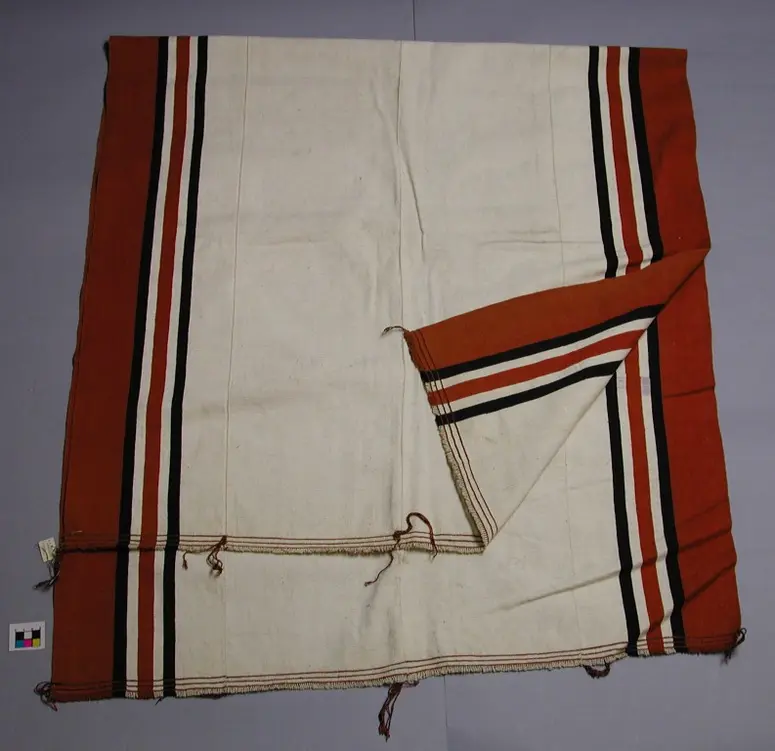
Body shawl
20. Jahrhundert | Christoph von Fürer-Haimendorf
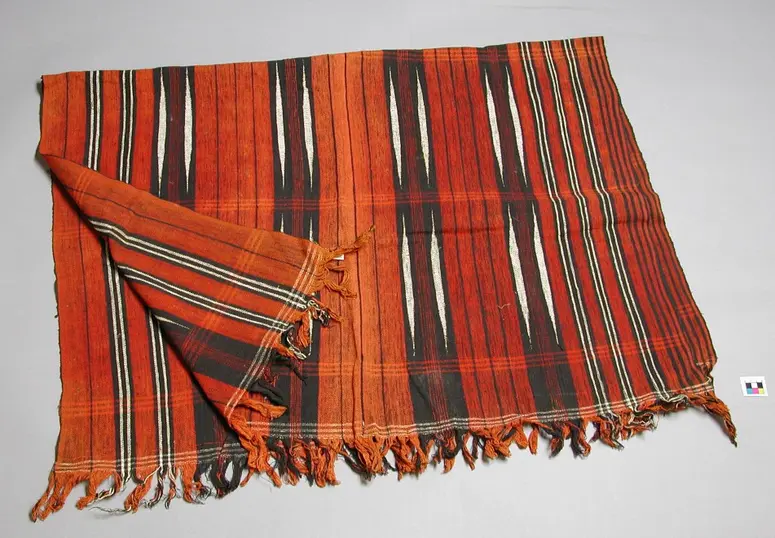
Among the Naga, men and women wear such shawls as a cloak wrapped over the upper body or folded over the shoulder, with the ends tucked into the belt. They are woven exclusively by women. They are mainly involved in productive and agricultural activities, while men are mainly responsible for social and ritual activities such as hunting; in ancient times, this also included war and headhunting. If they were to carry out female activities, such as weaving, they would lose their specific skills and "become women". However, women are also subject to taboos in weaving. As this activity can disrupt fertility, in many groups it is only carried out in the period between the harvest and the next sowing, but never when the men are out hunting or at war.
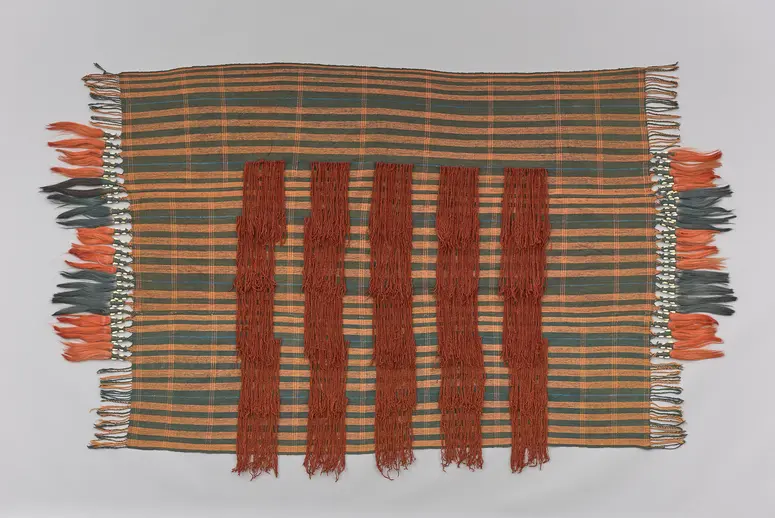
A shawl of the type shown here was the most prestigious textile worn by men from the Ao-Naga tribe and represented the ideal of male identity. The patterns on the centre stripe, which was made by men and subsequently inserted into the cloth woven by women, refer to the aspects of the wearer's person of which he was particularly proud. No motif was merely decorative; rather, insiders could tell from the abstract pattern what rank the wearer held in traditional society. Status was acquired through success as a warrior or by holding festivals of merit. Social prestige increased with the number of bulls, Mithun cattle and pigs that were sacrificed to feed the village community. The stylised Mithun heads on the central strip also show how many generations of the wearer's ancestors had already organised such festivals, which ultimately served to transform wealth into status.
All these meanings were lost with the rapid cultural change; today such cloths serve more as a symbol of identity for the Ao as a tribe.
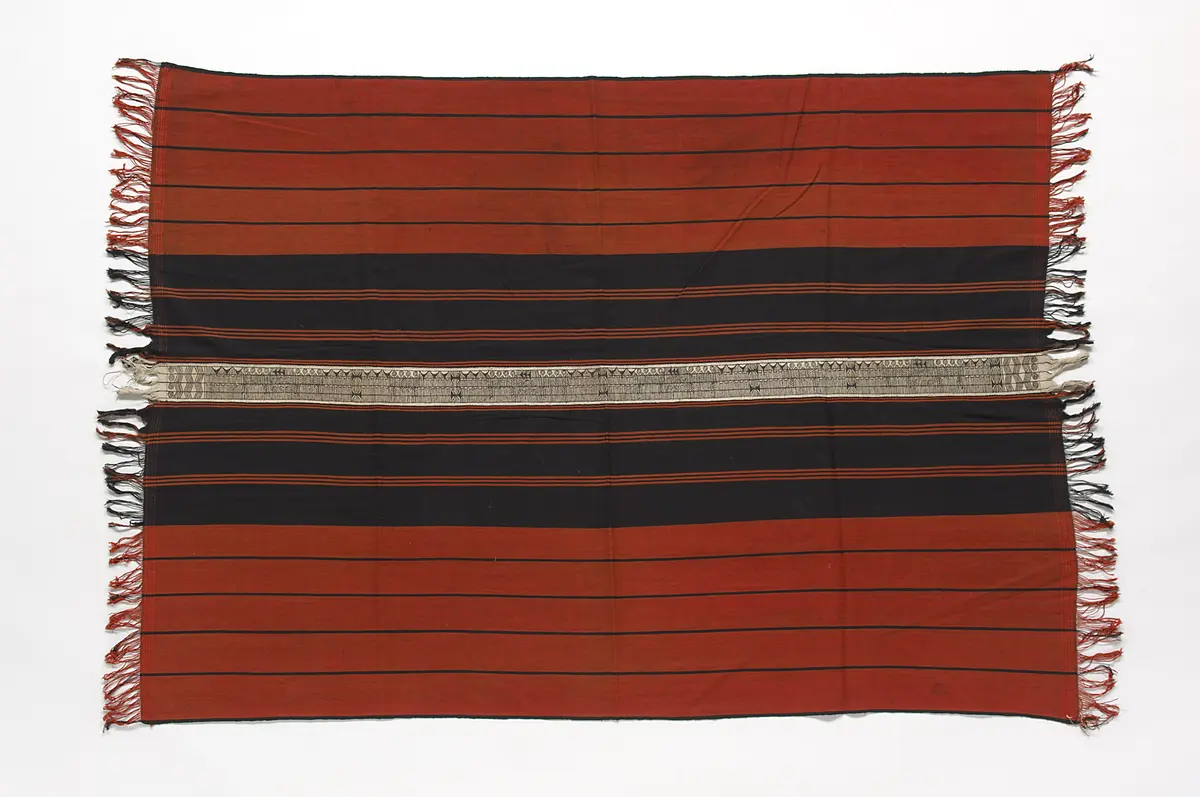
Among the Naga, men and women wear such shawls as a cloak wrapped over the upper body or folded over the shoulder, with the ends tucked into the belt. They are woven exclusively by women. They are mainly involved in productive and agricultural activities, while men are mainly responsible for social and ritual activities such as hunting; in ancient times, this also included war and headhunting. If they were to carry out female activities, such as weaving, they would lose their specific skills and "become women". However, women are also subject to taboos in weaving. As this activity can disrupt fertility, in many groups it is only carried out in the period between the harvest and the next sowing, but never when the men are out hunting or at war.
A shawl of the type shown here was the most prestigious textile worn by men from the Ao-Naga tribe and represented the ideal of male identity. The patterns on the centre stripe, which was made by men and subsequently inserted into the cloth woven by women, refer to the aspects of the wearer's person of which he was particularly proud. No motif was merely decorative; rather, insiders could tell from the abstract pattern what rank the wearer held in traditional society. Status was acquired through success as a warrior or by holding festivals of merit. Social prestige increased with the number of bulls, Mithun cattle and pigs that were sacrificed to feed the village community. The stylised Mithun heads on the central strip also show how many generations of the wearer's ancestors had already organised such festivals, which ultimately served to transform wealth into status.
All these meanings were lost with the rapid cultural change; today such cloths serve more as a symbol of identity for the Ao as a tribe.
Collection:
Christoph von Fürer-Haimendorf (1909 Wien - 1995 London) DNB
Time:
20. Jahrhundert
Object Name
Schultertuch
Culture
Nagaland / Ao
Material/technology:
Baumwolle, Leinwandbindung, Bemalung, Färbung im Garn, Fransen aus Kettfäden - gedreht
Copyright
Weltmuseum Wien
Collection area
South Asia, Southeast Asia, Himalayas
Geography
Südasien/Subkontinent/Indien/Assam/Nugma
Invs.
126434
Browse more Similar items you might be interested in

Bana Linga Franz Ferdinand von Österreich-Este 19th century