Kesselgong
2./1. Jahrhundert v. Chr. | Franz Heger
This gong, found in the Red River delta in northern Vietnam, is considered to be the original form of a series of developments that spread across Thailand, Laos, Burma and southern China to Indonesia.Let's go back to the turn of time, to the roots of the cultural identity of today's Vietnam (which was not to exist for a long time). These roots lie in the delta of the Red River. They left their pictorial expression on the kettle gongs of the Dong Song culture with their decorations - ships of the dead, buildings, animals and people. The birds depicted on one of the innermost circles refer on the one hand to the shamans' flights into the afterlife, and on the other - and this is politically more important - they were the totem animal of the clan of the first rulers of the Dong Son culture. Geometric patterns represent the order of the cosmos. Elements of the universe such as the sky, the earth or humanity are depicted in concentric circles that revolve around the sun in the center, thus referring to cosmic harmony.
The sound of the gongs accompanied the dead to the afterlife and warded off evil spirits, and above all it summoned the dragon, which alone could bring the vital rain for the rice fields. Only the rulers were allowed to strike these instruments, only they could ensure survival in a culture based on wet rice cultivation. Their exclusive right to these gongs legitimized their rule. A rule that came to an abrupt end with the occupation of the Red River Delta by the Chinese in 111.
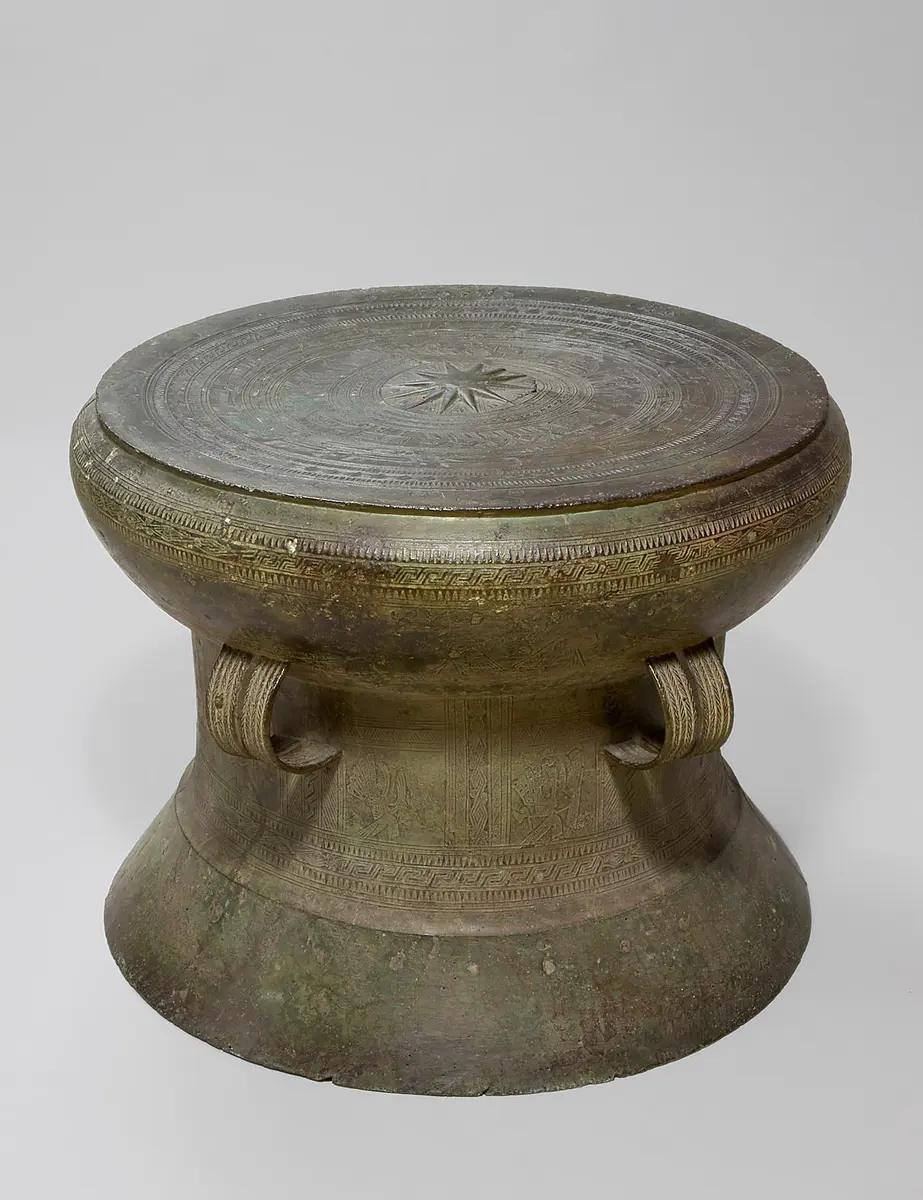
This gong, found in the Red River delta in northern Vietnam, is considered to be the original form of a series of developments that spread across Thailand, Laos, Burma and southern China to Indonesia.Let's go back to the turn of time, to the roots of the cultural identity of today's Vietnam (which was not to exist for a long time). These roots lie in the delta of the Red River. They left their pictorial expression on the kettle gongs of the Dong Song culture with their decorations - ships of the dead, buildings, animals and people. The birds depicted on one of the innermost circles refer on the one hand to the shamans' flights into the afterlife, and on the other - and this is politically more important - they were the totem animal of the clan of the first rulers of the Dong Son culture. Geometric patterns represent the order of the cosmos. Elements of the universe such as the sky, the earth or humanity are depicted in concentric circles that revolve around the sun in the center, thus referring to cosmic harmony.
The sound of the gongs accompanied the dead to the afterlife and warded off evil spirits, and above all it summoned the dragon, which alone could bring the vital rain for the rice fields. Only the rulers were allowed to strike these instruments, only they could ensure survival in a culture based on wet rice cultivation. Their exclusive right to these gongs legitimized their rule. A rule that came to an abrupt end with the occupation of the Red River Delta by the Chinese in 111.
Collection:
Franz Heger (1853 Brandeis - 1931 Wien) DNB
Time:
2./1. Jahrhundert v. Chr.
Object Name
Kesselgong
Culture
Nord-Vietnam / Dong son Kultur
Material/technology:
Bronze, Kupferlegierung
Copyright
Weltmuseum Wien
Collection area
South Asia, Southeast Asia, Himalayas
Geography
Südostasien/Festland/Vietnam
Invs.
83624
Browse more Similar items you might be interested in


Bana Linga Franz Ferdinand von Österreich-Este 19th century